हमें ईमेल करें :
info@labcompanion.cn
-

-

कॉल का अनुरोध करना :
+86 18688888286

The Core of ESS Screening Lies in Accurate Stress Application
Environmental Stress Screening (ESS) is an indispensable quality control link in the manufacturing process of electronic products. Its core goal is not to test whether a product can "survive" under extreme conditions, but to accelerate the exposure of potential defects in product design, materials, and processes—such as solder joint cracking, chip delamination, and poor packaging airtightness—by applying controllable stresses such as rapid temperature changes and random vibrations. If these defects are not screened out, they may cause early failures in the user field, resulting in high maintenance costs and loss of brand reputation.
In ESS screening, the temperature change curve applied by the rapid temperature change test chamber directly determines the effectiveness and consistency of the screening. A core technical question long discussed in the industry is: which one can more effectively stimulate potential product defects, linear temperature change or nonlinear temperature change? The answer is not a simple "either/or", but depends on the physical characteristics of the product, failure mechanism, and the strictness of screening standards.
With more than 20 years of experience in the field of rapid temperature change chambers, Lab Companion has achieved high-precision reproduction of any preset temperature change curve (including complex nonlinear curves) within the full temperature range of -70℃ to +180℃, relying on advanced coupled control algorithms for refrigeration/heating systems. This article will analyze how Lab Companion redefines the efficiency and precision standards of ESS screening through precise temperature change curve control from three dimensions: technical principles, solutions, and selection strategies.
Part 1: Technical Divide – Analysis of Linear and Nonlinear Temperature Change Principles
To clarify the differences between linear and nonlinear temperature changes, it is first necessary to define the core concept of "temperature change rate" in ESS screening, as well as the essential differences and applicable scenarios of the two modes.
1.1 Nonlinear Temperature Change: A Natural Characteristic of Traditional Modes
In the design of early rapid temperature change chambers, most equipment adopted the control method of "full-power heating" and "full-power refrigeration": when the controller detects the need for temperature rise, the heater outputs at full power; when temperature drop is required, the compressor or liquid nitrogen valve is fully opened. This "open-loop" control mode leads to the actual operating trajectory of the temperature inside the chamber showing an exponential curve—with a fast temperature change rate at the initial stage and a gradual slowdown when approaching the target temperature, which is known as nonlinear temperature change.
The core characteristic of nonlinear temperature change is that the average temperature change rate can reach a relatively high level, but the actual temperature change curve is not a uniform straight line. For many traditional ESS screening standards, nonlinear temperature change can already meet basic screening needs, and the equipment implementation cost is relatively low, making it widely used in early electronic product manufacturing.
1.2 Linear Temperature Change: A Higher Requirement for Stress Consistency
With the improvement of electronic product integration and the complexity of packaging technology, the difference in thermal expansion coefficients (CTE) of different materials inside the product leads to increasingly sensitive thermal stress distribution. The "fast first, slow later" rate fluctuation of nonlinear temperature change will cause inconsistent thermal stress experiences between the product surface and core, as well as different solder joint positions, thereby reducing the repeatability and comparability of screening results and failing to meet the screening needs of high-end products.
Linear temperature change (also known as "linear rapid temperature change") requires the temperature inside the chamber to change at a fixed and uniform rate over time—for example, 10℃/min. During the entire process of heating from -40℃ to +85℃, the temperature rises by an accurate 10℃ every minute. In this mode, every segment of temperature change stress experienced by the product is uniform and predictable, which is crucial for research and certification tests that require strict reproduction of test conditions (such as AEC-Q100, IEC 60068-2-14 Nb test methods) and is the core demand for high-end electronic product screening.
1.3 Implementation Difficulties: Three Major Technical Challenges of Linear Temperature Change
Achieving high-precision linear temperature change requires much higher hardware and software coordination capabilities of the equipment than nonlinear temperature change, and it mainly faces three major technical challenges:
• Dynamic Matching of Refrigeration/Heating Power: During the temperature change process, the heat capacity of the chamber insulation layer, the sample itself, and environmental heat dissipation will all affect the actual required net power in real time. The controller must calculate and adjust the compressor level and heater output in real time to effectively resist temperature overshoot caused by thermal inertia and ensure stable rate.
• Linear Maintenance Within the Full Temperature Range: In the low-temperature section (-70℃ to -40℃), the refrigeration efficiency is high but the heater needs to work together to offset excessive cooling; in the high-temperature section (+100℃ to +180℃), the heating demand is large and the refrigeration system needs to participate appropriately to balance overheating. Maintaining uniform linearity in the full temperature range requires complex system coupling control.
• Adaptability to Load Changes: Different samples have significant differences in thermal load. A device that can perfectly achieve linear temperature change under no-load conditions is prone to rate deviation when loaded with high-heat-capacity samples. Therefore, high-quality linear temperature change chambers must have adaptive load compensation capabilities to cope with load fluctuations in different scenarios.
Part 2: Lab Companion's Solution – A Precise Curve "Sculptor"
Faced with the technical difficulties of linear temperature change and the diverse screening needs of the industry, Lab Companion has developed a temperature change control system with high-precision curve reproduction capabilities through in-depth integration of hardware and software, accurately solving the linear and nonlinear control challenges in ESS screening.
2.1 Core Algorithm: H-PID Dynamic Balance and Feedforward Control
Lab Companion's independently developed Q8 series controller is equipped with an exclusive H-PID dynamic balance algorithm. Different from traditional PID control that only responds passively when the temperature deviates from the set point, the H-PID algorithm introduces a feedforward control module, which can pre-calculate the estimated heating/refrigeration power required according to the preset temperature change rate and the current temperature point, dynamically adjust the compressor level, heater PWM duty cycle, and expansion valve opening, and achieve "predictive" precise control.
Test data shows that during the linear heating process of 10℃/min, the control system can adjust the output in advance according to the real-time feedback temperature deviation and the temperature change trend in the next few seconds, completely eliminating the lag caused by inertia. Within the full range of -70℃ to +180℃, the actual rate deviation of linear temperature change of Lab Companion's rapid temperature change chamber can be controlled within ±0.5℃/min, and the temperature fluctuation during steady state is ≤±0.3℃, far exceeding industry standards.
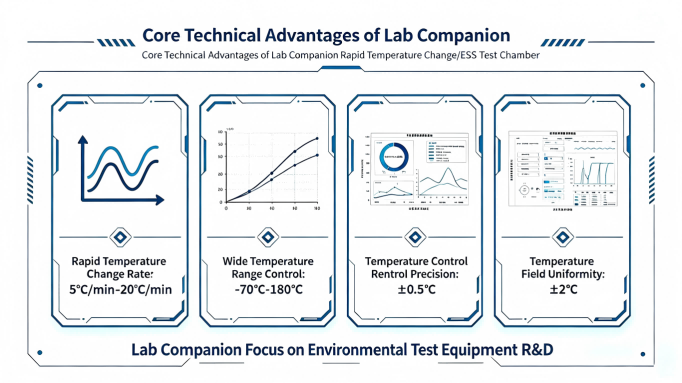
2.2 Efficient Coupling of Refrigeration/Heating Systems
Lab Companion's rapid temperature change chamber adopts a split structure design, with the refrigeration unit placed externally, and the high-efficiency evaporator and low-noise centrifugal fan retained inside the chamber, balancing temperature control precision and operational stability. On the refrigeration side, French Taikang scroll compressors are selected, combined with electronic expansion valves (EEV) to achieve stepless capacity adjustment (10%~100% continuously adjustable), avoiding temperature change rate fluctuations caused by frequent start-stop and power steps of traditional thermal expansion valves; on the heating side, solid-state relays (SSR) are used to drive nickel-chromium alloy heaters to achieve linear power output, ensuring stable and controllable heating rate.
Through two-way PID adjustment, the refrigeration and heating systems can work together during the temperature change process: during rapid cooling, the compressor operates at full load and the heater is completely turned off; when approaching the target temperature, both output at a small power synchronously to form "counteractive" precise temperature control, effectively avoiding temperature overshoot and ensuring that the temperature change curve fits the preset trajectory.
2.3 High-Precision Reproduction Capability of Complex Nonlinear Curves
In addition to linear temperature change, many special product screenings require asymmetric curves or segmented variable rate curves. For example, when screening some sensitive components, it is necessary to heat from -40℃ to +125℃ at a rapid rate of 15℃/min, and then enter the heat preservation stage at a slow rate of 3℃/min when approaching +125℃ to avoid false failures caused by thermal shock and ensure the authenticity and reliability of screening results.
Lab Companion's Q8 controller supports multi-segment program editing, with a maximum of 100 modes, each containing 99 steps. Users can freely define the temperature change rate, target temperature, and duration of each segment. The built-in curve fitting algorithm of the system can automatically smoothly transition the inflection points between adjacent rate segments, ensuring that the actual operating trajectory is highly consistent with the preset curve; combined with USB data export and IoT remote monitoring functions, the temperature change curve of each screening can be fully recorded and traced to meet compliance requirements.
Part 3: Efficiency First – Optimal Temperature Change Curve Selection Strategy for Different Products
After mastering the precise temperature change curve control capability, how to select linear or nonlinear temperature change and determine the optimal temperature change rate according to product characteristics has become the key to improving screening efficiency and reducing costs. Based on more than 20 years of industry experience and a large number of customer cases, Lab Companion has summarized targeted selection strategies to achieve "precise screening and maximum efficiency".
3.1 Automotive Electronics: Linear Temperature Change is the "Passport" for Automotive-Grade Certification
Case: An automotive electronics enterprise needs to conduct AEC-Q100 Grade 2 (-40℃ to +125℃) temperature cycle testing on BGA packaged control chips. The standard clearly requires the use of linear temperature change, and the temperature change rate deviation must be controlled within ±15% of the specified value.
Lab Companion configured a rapid temperature change chamber with a linear rate of 15℃/min for it, ensuring that the full-range rate deviation is ≤±0.5℃/min through the H-PID algorithm, which fully meets the requirements of automotive-grade certification. Test results show that compared with the previously used nonlinear equipment, the detection rate of early delamination defects in the chip packaging layer has increased by 40%, and the consistency of test results between different batches has been significantly improved, helping the customer pass the automotive-grade certification quickly.
Conclusion: For products that need to meet strict certification standards such as automotive and military grades, prioritizing equipment with high-precision linear temperature change capability is the core premise to ensure the compliance and reliability of screening results.
3.2 Consumer Electronics: Nonlinear Temperature Change Balances Efficiency and Cost
Case: A mobile phone motherboard manufacturer needs to conduct rapid ESS screening on thousands of PCBA boards every day, with the core demand of eliminating process defects such as cold solder joints and poor solder joints. Its screening specifications allow the use of nonlinear temperature change, requiring only an average temperature change rate ≥10℃/min.
Nonlinear temperature change equipment is less difficult to implement and has lower procurement costs, and can achieve a higher average rate under the same refrigeration power. Lab Companion provided it with an economical nonlinear rapid temperature change chamber, which helped the customer reduce the equipment procurement budget by 20% while ensuring the defect detection rate, and shortened the single screening cycle time by 15%, greatly improving production efficiency.
Conclusion: For large-volume, non-certification on-line production screening, nonlinear temperature change is a cost-effective choice that balances screening efficiency and cost.
3.3 Multi-Material Hybrid Components: Custom Curves are the Key
Case: A military component includes an aluminum alloy shell, ceramic substrate, and epoxy potting adhesive, with significant differences in their thermal expansion coefficients (CTE). If a constant high-speed linear temperature change is adopted, the potting adhesive will crack due to concentrated thermal stress—such damage is not a real defect of the product, but an ineffective loss caused by excessive screening stress.
By analyzing the thermodynamic response of each material of the component, Lab Companion engineers customized a segmented nonlinear curve for the customer: a slow change of 3℃/min in the low-temperature zone of -55℃ to -20℃ to avoid epoxy adhesive brittleness; a high rate of 12℃/min in the main temperature zone of -20℃ to +85℃ to efficiently stimulate solder joint defects; and a slowdown to 5℃/min in the high-temperature zone of +85℃ to +125℃ to protect the ceramic substrate. This "customized stress application" not only achieves the screening purpose, but also avoids cost waste and product damage caused by excessive screening.
Conclusion: For multi-material and special-shaped components, in-depth collaboration with equipment suppliers to customize exclusive temperature change curves is the key to improving screening efficiency and ensuring yield.
Conclusion: Choose Lab Companion to Master the Core Competitiveness of ESS Screening
In environmental stress screening, "what kind of stress to apply" is equally important as "how to apply stress accurately". Linear and nonlinear temperature changes have no advantages or disadvantages, and each has its applicable scenarios. What really determines the upper limit of screening efficiency and precision is whether the equipment can accurately reproduce every temperature change curve preset by engineers.
Through independently developed H-PID dynamic balance algorithm, efficiently coupled refrigeration/heating systems, and multi-segment programmable controllers, Lab Companion has achieved high-precision control of linear, nonlinear, and segmented complex curves within the wide temperature range of -70℃ to +180℃. Whether your products need to meet AEC-Q100, IEC 60068-2-14 or GJB 150.5A standards, Lab Companion can provide tailor-made precise temperature change curve solutions.
More importantly, Lab Companion does not only sell equipment, but also provides full-process technical services from product characteristic analysis, temperature change curve selection to on-site verification. With more than 20 years of industry experience, we can help customers scientifically select the optimal temperature change mode, maximize screening efficiency, and avoid cost waste and product damage caused by excessive screening, helping enterprises build a solid product quality line of defense.
 एक कहावत कहना


 IPv6 नेटवर्क समर्थित