1. CPO Industry Transition: From Lab Validation to Mass Production
Driven by the rapid expansion of AI computing clusters, optical interconnection architectures are accelerating the shift from traditional pluggable optical modules to Co-packaged Optics (CPO) and Near-packaged Optics (NPO). Leading global players are scaling next-generation CPO switching platforms, while Chinese manufacturers are advancing prototype verification and mass production layout, pushing CPO from technical exhibition scenarios toward commercial deployment.
By co-packaging optical engines and switch chips on a single substrate, CPO shortens optical signal transmission paths and reduces power loss. However, this highly integrated structure brings higher thermal density and more complex temperature stress distribution. At the mass-production stage, the core industry challenge is no longer technical feasibility, but high-reliability, low-cost, and large-scale manufacturability.
2. New Reliability Challenges Brought by CPO Architecture Innovation
The rapid growth of large-scale GPU clusters has completely reshaped data center interconnection requirements. Traditional copper cable interconnection cannot meet the high-bandwidth, low-latency demands of AI clusters. Optical interconnection is now deployed closer to computing chips, extending from cabinet-to-cabinet transmission down to chip packaging level.
Unlike conventional pluggable optical modules — which can be replaced individually after failure — CPO integrates optical and electrical chips into one sealed package. Any single device failure may lead to the replacement of the entire system. This fundamental change makes temperature cycling reliability the core indicator of CPO mass production qualification.
3. Three Core Barriers Restricting CPO Commercialization
3.1 Ultra-low insertion loss requirements for optical coupling
A qualified CPO system requires optical coupling efficiency above 95% and single-joint insertion loss controlled below 0.5 dB, to maintain overall package loss within 1.8–3 dB. CPO packages multiple heterogeneous materials — including silicon photonic chips, laser chips, ceramic substrates, epoxy resin, and copper interconnects — with a thermal expansion coefficient difference of 2–8 times among materials. Repeated temperature cycling generates periodic thermo-mechanical stress, causing nanometer-level displacement of optical fibers and photonics alignment structures, which directly increases optical loss and deteriorates system performance.
3.2 Severe yield superposition risks
CPO presents extreme yield superposition effects. Assuming a 95% individual optical engine assembly yield, a single switch chip integrating 32 optical engines will achieve a system-level yield of only 19%. Complex packaging and high integration significantly raise manufacturing thresholds, leading the industry to predict large-scale CPO commercialization will be delayed until 2028–2029.
3.3 Difficult post-maintenance
Pluggable modules support rapid on-site replacement. In contrast, CPO’s highly integrated packaging fixes optical engines and switch chips as a whole. Once the laser or optical engine fails, the entire board needs replacement. The industry is promoting external laser source solutions to reduce maintenance costs, placing vulnerable components at replaceable panel positions.
4. Strict Temperature Cycling Reliability Standards for CPO
CPO devices face far more stringent thermal reliability tests than traditional optical modules, mainly reflected in thermal failure mechanisms and optical parameter temperature sensitivity.
High thermal density inside CPO packages causes thermal interface material fatigue, pump-out, and dry aging during rapid temperature cycling, continuously increasing thermal resistance. Typical failure modes include solder ball fatigue, gold wire bonding fracture, TEC delamination, substrate warpage, and fiber coupling offset — a unique failure mode of CPO devices.
Optical engines are extremely temperature-sensitive. The wavelength drift coefficient of DFB lasers is 0.08–0.1 nm/°C. With mainstream DWDM channel spacing of only 0.8 nm, tiny temperature fluctuations will cause wavelength deviation, crosstalk rise, and increased bit error rate. Therefore, CPO temperature cycling tests must monitor real-time optical parameter stability rather than only structural integrity.
Global industrial test standards form a complete certification matrix:
• GR-468-CORE: Temperature range -40 °C to +85 °C, linear temperature rate ≥ 10 °C/min, minimum 500 cycles, 10-minute dwell time at extreme temperatures.
• High-end 1.6T/ LPO upgrade criteria: Extended range of -55 °C to +125 °C, temperature rate ≥ 15 °C/min.
• JEDEC JESD22-A104 & IEC 60068-2-14: Mandatory supplier qualification evaluation standards.
5. Lab Companion Full-level CPO Thermal Validation Solutions (China High-end Manufacturing)
Lab Companion is a professional environmental test equipment manufacturer rooted in China, with 20+ years of R&D and manufacturing experience in reliability testing equipment. Supported by three major production bases in Dongguan, Kunshan and Chongqing, covering a plant area of over 6,000 ㎡ and an annual capacity of 1,000 sets of environmental chambers, the brand represents high-precision, cost-effective, and stable Chinese industrial manufacturing capabilities for global optical communication and semiconductor customers.
Global Service Note: For overseas clients, Lab Companion provides full-process online technical guidance, remote debugging, program setting, and after-sales support. No on-site door-to-door service is available in overseas regions. Professional online support ensures consistent test accuracy and equipment operation efficiency worldwide.
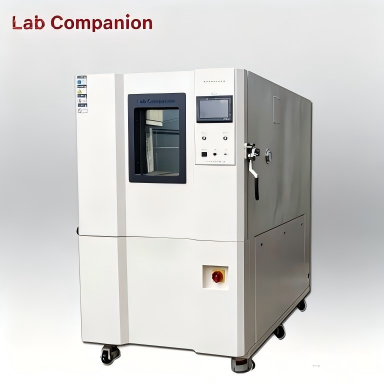
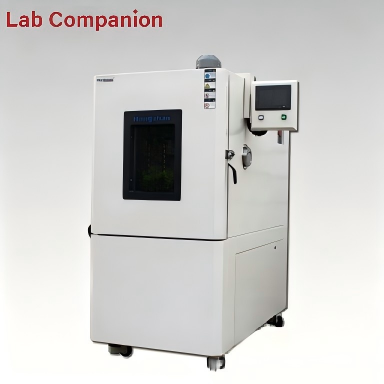
5.1 Optical Engine & Module-level Solution: TC Series Rapid Temperature Change Chamber
The Lab Companion TC series is specially optimized for high-density CPO optical engine screening.
• Temperature range: Standard -70 °C ~ +150 °C, extended extreme test range -55 °C ~ +125 °C
• Temperature rate: 5/10/15/20/25 °C/min (full loaded actual test rate, linear controllable)
• High precision control: Temperature fluctuation ≤ ±0.3 °C, uniformity ≤ ±2.0 °C, fully compliant with GR-468 linearity and consistency requirements
• Mass production adaptability: Compact chamber structure with multi-layer sample racks, supporting batch screening of hundreds of optical engines per cycle, matching mass production ESS screening rhythm
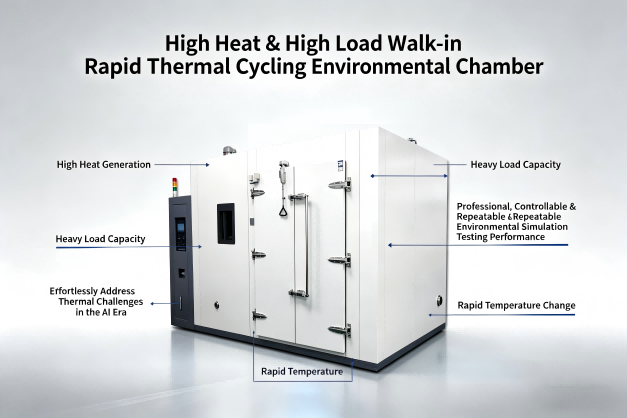
5.2 System & Rack-level Solution: Walk-in Rapid Temperature Change Chamber
For full CPO switch system and server cabinet verification, Lab Companion provides large-scale walk-in temperature cycling chambers:
• Volume range: 1,000L–10,000L
• Load capacity: 1,000 kg mechanical load, supporting 50 kW DUT self-heating test
• Working conditions: -20 °C ~ +55 °C, temperature rate ≥ 5 °C/min
• Application: Full-system loaded temperature cycling test for complete CPO switching platforms
5.3 MES docking & full data traceability
All Lab Companion test chambers support real-time recording of temperature curves, rate changes, and dwell data. Equipped with standard Ethernet and RS485 interfaces, and optional OPC UA / Modbus TCP protocols, the equipment can seamlessly connect with factory MES systems to build full-lot, full-process quality traceability, meeting international certification audit requirements.
6. Reliability Determines the Long-term Commercial Value of CPO
The global CPO market is transitioning from technical verification to large-scale manufacturing. In the next 3–5 years, the core competition of CPO products will focus on mass-production reliability rather than basic technical implementation.
From micro-level optical engine stress screening to full-system cabinet-level thermal verification, Lab Companion (China High-end Manufacture) provides standardized, compliant, and efficient temperature cycling test solutions for global CPO and optical communication clients. With reliable Chinese manufacturing quality and professional overseas online after-sales system, Lab Companion supports global customers throughout the entire R&D verification and mass production screening process.
As CPO market penetration grows from 0.5% (2026) to 35% (2030), standardized and high-precision environmental reliability test equipment will remain the core guarantee for product long-term stable operation.
Booming Shanghai AI Computing Industry Brings New Thermal Testing Challenges
As a core hub for AI chip R&D and computing infrastructure in China, Shanghai’s Zhangjiang and Caohejing industrial clusters have witnessed explosive growth in domestic high-performance AI chips. Since 2026, local leading enterprises have achieved remarkable market breakthroughs: Biren Technology has successfully listed on the Hong Kong Stock Exchange with an oversubscription ratio exceeding 2,300 times and a peak market value of HK$100 billion. Muxi Technology debuted on the STAR Market with a nearly 700% first-day surge, pushing its market value up to RMB 350 billion. OriginAI has completed IPO counseling and is accelerating its listing process. Three of China’s top four domestic GPU developers are rooted in Shanghai, forming a leading industrial cluster for high-end AI chip innovation.
The regional industrial advantages continue to expand. Hygon AI’s regional headquarters has settled in Pudong Zhangjiang, while Yuntiantianxin advances the industrialization of high-power inference chips. As Shanghai’s AI computing hardware rapidly upgrades in performance, extreme heat generation has become a critical bottleneck for reliability validation.
High-computing AI chips produce massive instantaneous heat during parallel computing tasks. Without rigorous thermal cycling verification in R&D and mass production phases, devices are prone to frequency reduction, performance degradation and premature hardware failure. Traditional thermal test equipment can no longer adapt to the high-power, large-scale, high-precision testing requirements of modern AI chips and server systems. To address these industry pain points, Lab Companion has developed high-acceleration fast temperature change chambers, delivering standardized, high-reliability environmental test solutions for global AI computing hardware manufacturers.
Three Core Testing Pain Points of High-Power AI Chips
Compared with traditional consumer electronics chips, AI GPUs, server motherboards and full rack servers feature ultra-high power consumption, severe thermal accumulation and oversized test specimens, bringing three major technical challenges to temperature cycling tests.
1. Severe Thermal Accumulation Causes Unstable Test Data
The thermal design power (TDP) of a single mainstream AI GPU reaches hundreds of watts. A multi-GPU server delivers a peak power consumption of over 10kW, while high-density racks exceed 50kW to 100kW — 3 to 5 times higher than traditional servers. During temperature cycling tests, the self-heating of DUTs (devices under test) distorts the internal temperature field of the chamber, causing significant deviations between the set temperature and the actual ambient temperature around specimens. This results in poor repeatability and authenticity of test data, failing to meet international reliability standards.
2. Traditional PID Control Leads to Temperature Overshoot & Specimen Damage
Qualified fast temperature change tests require smooth heating and cooling processes without overshoot or delay. However, conventional PID control struggles with high-heat-load AI devices. It provides insufficient power during heating and generates severe temperature overshoot when approaching the target value due to sudden heat release from high-power chips. Excessive temperature deviation not only violates IEC and JESD test specifications but also damages expensive engineering samples, raising R&D costs significantly.
3. Limited Chamber Volume Fails Full-System-Level Testing
Modern AI reliability testing has evolved from single IC testing to system-level verification of GPU motherboards, multi-GPU modules and complete server racks. Standard temperature change chambers cannot accommodate large-size DUTs. Forced placement blocks internal airflow, destroys temperature field uniformity, and fails to support full-system reliability validation for AI servers.
Lab Companion Core Technologies for High-Heat-Load AI Testing
Lab Companion TC/TH/ESS/CW series fast temperature change chambers are tailor-made for high-power, large-size AI computing hardware. With exclusive optimized control algorithms and structural design, the equipment supports full-scenario testing from single chips and modules to complete server racks.
1. Wide Temperature Rate Coverage with Linear & Non-Linear Modes
Lab Companion chambers feature a temperature range of-70℃ to +150℃, with temperature fluctuation ≤±0.5℃ and temperature deviation ≤±2℃. It supports multiple temperature change rates from 5℃/min to 25℃/min, with optional linear and nonlinear operation modes. Liquid nitrogen auxiliary cooling is available for ultra-fast cooling up to 30℃/min.
Linear temperature variation ensures constant and smooth temperature gradients, perfectly matching standardized compliance tests that require strict rate consistency. Nonlinear mode simulates real-world operating conditions such as equipment startup/shutdown and load fluctuation, reproducing actual thermal shock environments for more credible test results.
2. Patented Adaptive Thermal Load Control Algorithm Eliminates Overshoot
To solve the overshoot problem caused by high self-heating of AI chips, Lab Companion adopts a patented cold-end adaptive control system, upgrading traditional PID logic. The system collects real-time data from multiple temperature sensors inside the chamber and on specimen surfaces, dynamically identifies the real-time power load of DUTs, and intelligently adjusts compressor output and heater compensation to offset self-heat interference.
Even under high-speed temperature cycling above 15℃/min, the equipment achieves smooth temperature transition with strictly controlled overshoot range. It ensures the thermal stress applied to specimens fully complies with international standards, guaranteeing test accuracy and protecting high-value test samples.
3. Large Walk-In Chambers for Full-Rack System-Level Testing
Lab Companion walk-in fast temperature change chambers cover a volume range from 1m³ to 10m³, with customizable oversized dimensions to accommodate standard 42U AI server racks and complete system equipment. The series supports ultra-high thermal load testing, bearing 1,000kg aluminum ingots plus 50kW continuous heat load, with expandable load capacity for customized demands.
Equipped with a multi-point three-dimensional air supply system, high-power centrifugal fans and adjustable deflectors, the chamber forms a full-domain forced convection circulation. Under full-load conditions, the temperature uniformity ≤±1.5℃ and fluctuation ≤±0.5℃, fully meeting GJB and IEC requirements for large-scale specimen reliability testing.
4. Precise Humidity Control Prevents Condensation & Corrosion
Extreme temperature differences during AI chip thermal cycling easily cause surface condensation during temperature recovery, leading to short circuits, circuit corrosion and performance failure. Lab Companion’s integrated boiler humidification system provides accurate humidity control ranging from 20%RH to 98%RH, stably maintaining low humidity conditions of 45%RH at 0℃. It effectively eliminates condensation risks and ensures safe and stable testing of high-precision AI chips.
5. Independent Intelligent Control System with Full Data Traceability
Lab Companion’s self-developed C100 PID control system integrates fuzzy logic algorithms with bilingual (Chinese/English) visual operation interfaces for simple and efficient parameter configuration. The system automatically coordinates refrigeration, heating, dehumidification and humidification subsystems to achieve high-precision full-range temperature and humidity control. It supports intelligent fault self-diagnosis with real-time fault prompts and historical record storage for rapid maintenance.
Equipped with Ethernet and IoT remote monitoring functions, the equipment allows engineers to check operating status and test progress via mobile terminals anytime. All test data, temperature curves and fault records can be exported and backed up, fully complying with IATF 16949, ISO 17025, GJB and IEC data traceability standards.
Typical Application Scenarios for AI Computing Hardware
Scenario 1: GPU Motherboard Temperature Cycle Aging Test
A leading Shanghai AI chip designer conducted reliability verification for high-power GPU motherboards per the JESD22-A104 standard. Test conditions: -55℃ to +125℃, 15℃/min temperature rate, 1,000 thermal cycles. Adopting the Lab Companion TC-1000 fast temperature change chamber, the temperature overshoot was strictly controlled within ±0.5℃ with stable field uniformity. After 1,000 cycles, no cracking, welding failure or structural damage occurred on the GPU motherboard, completing successful reliability validation.
Scenario 2: AI Server Full System Temperature-Humidity Coupling Test
A server manufacturer performed extreme environmental reliability tests on fully loaded AI server racks. The test procedure included 48-hour high-temperature and high-humidity storage at 55℃/95%RH, 24-hour low-temperature storage at -20℃, and temperature recovery cycling. The Lab Companion CW2000 walk-in chamber easily accommodated standard 42U racks and supported external liquid cooling pipeline access for real-time monitoring of core hotspot temperatures. The equipment operated stably for over 300 hours without temperature anomalies or thermal load interference, verifying the long-term stability of server heat dissipation and overall structure.
Scenario 3: ESS Environmental Stress Screening for Multi-GPU Modules
An AI module manufacturer required 100% production-line stress screening to eliminate potential manufacturing defects. Lab Companion ESS series chambers adopt dual/triple-chamber alternating design, realizing seamless switching between testing, pre-heating and pre-cooling to match automated production rhythms. With 24 high-precision temperature acquisition channels, the equipment monitors the real surface temperature of each GPU chip, records temperature deviation data, and generates standardized test reports automatically, meeting strict quality control and traceability requirements for mass production.
Global Online Technical Support System
To serve global enterprise clients efficiently, Lab Companion adopts an online-first technical support system (no on-site door-to-door service for overseas users), providing full-cycle professional technical guarantee:
• Fast Remote Response: Professional technical teams provide remote diagnosis, operational guidance and fault troubleshooting with rapid response worldwide.
• Online Technical Training: Offer remote operational training, standardized SOP documents and customized testing process guidance to help teams master equipment operation quickly.
• Regular Remote Maintenance & Calibration Guidance: Provide periodic remote equipment inspection, calibration guidance and system optimization suggestions to ensure long-term high-precision operation.
• Complete Spare Parts Supply: Support global spare parts delivery and remote component replacement guidance to minimize equipment downtime.
Core Technical Advantages
Lab Companion fast temperature change chambers provide professional and reliable environmental test solutions for global AI chip and server manufacturers, with five core strengths:
• High Thermal Load Adaptability: Patented cold-end adjustment technology eliminates temperature overshoot under high-power load, ensuring precise testing and specimen safety.
• Flexible Temperature Change Rates: Support 5–25℃/min linear/nonlinear adjustable rates, up to 30℃/min with LN2 assistance, adapting to diverse international test standards.
• Full-Coverage Test Space: 1–10m³ large-capacity walk-in chambers support 50kW+ high thermal load for full-server-rack system-level testing.
• Independent & Intelligent System: Self-developed control system with full independent intellectual property rights, supporting remote monitoring and complete data traceability.
• Global Online Support: Professional remote technical team provides 24/7 online guidance, training and after-sales support for overseas clients.
Conclusion
With the continuous upgrading of global AI computing hardware, international standards for chip and server environmental reliability testing are becoming increasingly stringent. Lab Companion focuses on high-precision thermal testing technology, providing full-scenario reliability verification solutions from single chips and modules to complete server racks. By delivering stable, standardized and professional environmental test equipment and global online technical services, Lab Companion empowers global AI hardware enterprises to optimize product reliability and accelerate high-end industrialization development.
In the procurement of rapid temperature change test chambers, most enterprises focus squarely on "procurement budget" — comparing prices from multiple suppliers and negotiating relentlessly, mistakenly believing that saving tens of thousands of yuan in the early stage is a cost-saving victory. However, a severely overlooked truth is: over-customized equipment wastes far more than just the initial procurement cost; the hidden costs throughout its total lifecycle are often several times the initial price difference.
When an over-"upgraded" equipment is put into use, higher maintenance difficulty, more expensive repair parts, and staggering power consumption will quietly drain tens of thousands of yuan from the enterprise's accounts every year. Accumulated over three to five years, these hidden costs may even exceed the initial procurement price difference, trapping the enterprise in a dilemma of "saving money when buying, but losing money when using".
Through serving a large number of customers, Lab Companion has found that true "cost saving" is neither letting customers buy cheap but impractical equipment, nor spending a lot of money on a bunch of unused performance. Instead, it is to help customers achieve the optimal total cost throughout the equipment's lifecycle — from procurement and operation and maintenance to energy consumption — through a professional "false demand identification mechanism". This article will deeply analyze the three types of cost waste caused by over-customization and explain in detail how Lab Companion, with integrity and professionalism, helps customers guard every penny and achieve long-term cost reduction.
I. In-Depth Analysis: The Total Lifecycle Waste of Over-Customization Is Far More Astonishing Than Imagined
Many enterprises mistakenly think that over-customization only costs a little more during procurement. In fact, this "additional expenditure" will continue to expand throughout the entire service life of the equipment, forming three overlapping types of cost waste, which ultimately makes enterprises pay a heavy price.
(1) Procurement Cost Waste: The Most Intuitive "One-Time Blood Loss"
• Many merchants deliberately induce customers to upgrade temperature change rates, expand equipment capacity, and add non-standard functions, with each "upgrade" accompanied by a sharp price increase.
• Key Data: According to Lab Companion's statistics, the procurement budget for over-customized equipment is 20% to 40% higher than that for reasonably configured equipment on average.
• Example: A standard 150L, 10℃/min rapid temperature change chamber costs about 150,000 yuan; upgrading to 20℃/min, 300L with humidity function can soar to over 250,000 yuan — the extra 100,000 yuan is almost half a year's R&D equipment budget for SMEs, while most upgraded configurations are idle.
(2) Operation and Maintenance Cost Waste: A Hidden Burden of "Continuous Blood Loss" Every Year
Over-customized high-end configurations lead to higher operation and maintenance costs, mainly reflected in three aspects:
• Higher Calibration Costs: Non-standard or large-capacity equipment requires more test points and longer calibration time, with costs1.5 times higher than standard equipment on average.
• High Maintenance Difficulty & Cost: Non-standard systems lack standardized drawings and general accessories; failures require on-site original factory engineers and special-ordered parts, leading to long maintenance cycles (often several weeks) and high costs. Some special parts even need overseas procurement, affecting R&D progress.
• Rising Maintenance Costs: Complex configurations mean more maintenance points, increasing maintenance man-hours and consumable costs.
• Key Data: Annual operation and maintenance costs for over-customized equipment are 15% to 25% higher than reasonable configurations; accumulated over 8 years, additional costs can reach tens of thousands to over 100,000 yuan.
(3) Energy Consumption Cost Waste: A Long-Term Expense of "Burning Money" Every Day
Over-customized equipment causes huge energy waste even when under low load, mainly in three aspects:
• High Standby Power Consumption: High-power compressors are inefficient at no/low load, consuming more electricity even when not running at full capacity.
• Large Heat Loss: Large-capacity equipment has a larger heat loss area, requiring more energy to maintain constant temperature, especially in the constant temperature stage.
• Continuous Power Consumption of Auxiliary Systems: Standby circuits of added systems (humidity, remote monitoring) consume electricity even when not activated.
• Key Data: Annual energy consumption of over-customized equipment is 20% higher than reasonable configurations. Based on 0.8 yuan/kWh and 3,000 annual operating hours, extra electricity costs are thousands to tens of thousands of yuan per year; over 8 years, extra electricity bills can reach 50,000 to 100,000 yuan.
Total Waste Calculation: A typical over-customization case — 80,000 yuan extra in procurement, 5,000 yuan extra in annual operation and maintenance, 6,000 yuan extra in annual electricity bills. Over 8 years, total waste reaches 168,000 yuan — enough to buy a brand-new standard rapid temperature change chamber.
II. Lab Companion's Full-Process Cost Saving: False Demand Identification + Energy-Saving Design, Balancing Short-Term and Long-Term Benefits
In response to the three types of waste caused by over-customization, Lab Companion has established a full-process cost control system centered on the "false demand identification mechanism", focusing on three key links to achieve optimal total cost.
(1) Short-Term Cost Saving: Accurately Identify False Demands and Eliminate Over-Configuration
• Lab Companion's selection consultants first conduct in-depth research (sample heat load, test standards, site conditions, budget) instead of rushing to quote.
• Through a scientific evaluation model, they accurately distinguish "true demands" from "false demands" and refuse unnecessary upgrades:
• Temperature change rate: Recommend 5℃/min~10℃/min for ordinary electronic components (no need for ≥15℃/min).
• Equipment capacity: Recommend "maximum sample size × 1.5~2 times" to avoid energy waste from "large equipment testing small samples".
• Special functions: Only suggest adding necessary functions; no bundled sales.
Effect: Procurement budget reduced by 20% to 40% on average, fully meeting actual test needs.
(2) Long-Term Cost Saving (Operation and Maintenance): Adaptive Configuration + General Accessories, More Convenient and Cost-Effective
• Lab Companion adheres to "minor customization on a standard platform" and adopts a large number of internationally general standard accessories (France Taikang compressors, Denmark Danfoss expansion valves, Schneider electrical components).
• Core Advantages:
• Convenient calibration: Front standard interface, local metrology institute can complete calibration without disassembly, lower cost.
• Efficient maintenance: General accessories available locally; quick-dismantling design allows on-site replacement by enterprise electricians, shorter cycle and lower cost.
• Simple maintenance: Transparent maintenance process, user manual details operation methods, enterprises can complete daily maintenance independently.
Effect: Annual operation and maintenance costs saved by15% to 25% compared with over-customized equipment.
(3) Long-Term Cost Saving (Energy Consumption): Energy-Saving Design + No Idle Performance
• Lab Companion integrates multiple energy-saving technologies to reduce energy consumption fundamentally:
• Imported inverter compressor: Automatically adjusts output power according to load, avoiding inefficient operation.
• High-density insulation layer (80mm polyurethane foam): Minimal heat loss, less energy needed for constant temperature.
• Environmentally friendly refrigerant R404A: ODP-free, combined with optimized refrigeration cycle, comprehensive energy consumption 28% lower than traditional equipment (over 40% lower in constant temperature stage).
• No idle performance: Configuration matches actual needs, core components work in high-efficiency range.
Example: A 200L standard chamber consumes 12,000 kWh/year; an over-customized 300L chamber consumes 15,600 kWh/year (extra 2,880 yuan/year in electricity). Lab Companion's energy-saving configuration saves over 20% of energy costs annually.
III. Case Evidence: Full-Process Cost Saving, Lab Companion Helps Customers Save Tens of Thousands of Yuan Every Year
• Customer Background: A Jiangsu new energy battery module enterprise (energy storage battery R&D/production) purchased an over-customized rapid temperature change chamber in 2022.
• Over-Customized Scheme: 20℃/min temperature change rate, 800L volume, -70℃~150℃ temperature range, with humidity function; total procurement price: 480,000 yuan.
• Problems After Use:
○ Actual required temperature change rate: only 5℃/min (batteries are sensitive to rapid temperature changes).
○ Actual occupied volume: less than 400L (800L volume seriously idle).
○ Humidity function: never used (battery testing requires dry environment).
○ Extra Costs: Annual electricity bill over 28,000 yuan; 4,800 yuan for a single compressor maintenance.
• Lab Companion's Solution:
○ Real Demand: 3℃/min~8℃/min temperature change rate, 400L volume, -40℃~120℃ temperature range, no humidity function.
○ Recommended Scheme: Standard 400L rapid temperature change chamber, quotation: 280,000 yuan.
○ Additional Suggestion: Dispose of the original over-customized equipment (valued at 200,000 yuan) to reduce initial investment.
• Effect: Annual electricity bill dropped to less than 18,000 yuan; annual operation and maintenance cost saved by nearly 6,000 yuan; over 10,000 yuan saved annually, nearly 100,000 yuan saved in 8 years.
IV. Conclusion: Integrity Empowers Long-Term Development, Lab Companion Acts as the "Guardian" of Customers' Total Lifecycle Costs
• Key Insight: Over-customized equipment is like an iceberg — procurement price is only the tip; hidden costs of operation and maintenance, energy consumption are the main body under water. Focusing only on initial budget leads to the trap of "expensive when buying, more expensive when using".
• Lab Companion's Commitment: Integrity means helping customers make "lifetime regret-free" selection decisions. The "false demand identification mechanism" eliminates over-configuration waste; standardized configuration and general accessories reduce operation and maintenance costs; energy-saving design saves long-term energy consumption — one selection, long-term benefits.
• For enterprises pursuing cost reduction and efficiency improvement, purchasing a rapid temperature change chamber is a long-term investment. Lab Companion, with professional technology and honest service, acts as your total lifecycle cost guardian. Contact us for full-process cost calculation (procurement + operation and maintenance + energy consumption) to ensure every penny is well-spent.
In the rapid temperature change test chamber industry, an unspoken phenomenon that harms customer interests is quietly spreading: many merchants take advantage of customers' lack of professional knowledge about equipment parameters, deliberately exaggerate the necessity of "high-end configurations", and induce customers to customize non-standard equipment that far exceeds their actual needs. From temperature change rate to volume size, from special functions to material grades, every link that can be "upgraded" has become a tool for merchants to earn high price differences. The final result is that customers pay a high price but end up with a lot of idle performance — 80% of the "high-end configurations" are never used when the equipment is in operation. The lack of industry integrity has turned test equipment that should serve product R&D into a tool for merchants to harvest profits.
With more than 20 years of in-depth experience in the industry, Lab Companion has witnessed countless small and medium-sized enterprises trapped by "induced over-customization". For this reason, Lab Companion resolutely took a path opposite to the industry chaos: no inducement, no exaggeration, no concealment. With the "false demand identification mechanism" as the core, it takes the initiative to help customers avoid the trap of over-customization, ensuring that every penny of procurement budget is spent wisely. The following will clearly demonstrate the core logic of "adaptation is optimal" by analyzing industry inducement tactics and comparing Lab Companion's honest practices.
I. Analysis of Industry Chaos: 3 Common Tactics of "Induced Over-Customization" (with Real Cases)
Tactic 1: Exaggerating Demands — Packaging "Ordinary Needs" as "High-End Needs"
• Core Operation: When contacting customers, merchants deliberately raise the threshold of test standards, using words such as "industry mainstream upgrade" and "future standard update" to mislead customers into thinking that ordinary configurations cannot meet their needs, and then recommend high-end models.
• Specific Scenario: A customer's product actually only needs to perform routine temperature cycle tests in GB/T 2423 (a temperature change rate of 5℃/min ~ 8℃/min is sufficient), but the merchant claims that "the industry mainstream has been upgraded to 15℃/min" and "if you don't buy high-speed equipment, you will definitely fail to meet the standards when they are updated in the future".
• Real Case: A medical device enterprise purchased a rapid temperature change chamber. Its product test standard clearly requires a temperature change rate ≤ 5℃/min, but the merchant repeatedly recommended a high-end model with 15℃/min, on the grounds that "it may be used for future product upgrades". In the end, the enterprise spent nearly 200,000 yuan more, and the high-speed function of the equipment has never been turned on in three years of use.
Tactic 2: Concealing Parameter Matching Relationships — Only Emphasizing "Non-Standard Customization is More Professional"
• Core Operation: Evading the key information that "the temperature change rate is restricted by multiple factors such as sample heat load, volume size, and refrigeration unit power", only exaggerating the advantages of "non-standard customization", inducing customers to upgrade configurations, but failing to inform them that the actual improvement is limited.
• Specific Scenario: A device with a nominal no-load rate of 15℃/min may have its actual rate drop sharply to below 8℃/min when a large-mass or high-heat-generating sample is placed. However, merchants deliberately avoid this point during model selection, only emphasizing that "we can customize higher specifications", inducing customers to upgrade the compressor unit, increase the condenser, and incur unnecessary costs.
• Real Case: A battery module manufacturer needed to conduct -40℃ ~ 85℃ temperature cycle tests, and the samples themselves generated a lot of heat. The merchant promoted a "customized solution" with super large cooling capacity, which was 50% more expensive than the standard model. In fact, the test had no high requirements for temperature change rate, and the standard equipment was fully competent. The customer spent several hundred thousand yuan more, only to get an underloaded "overkill" equipment. The frequent start-stop of the refrigeration unit even shortened its service life.
Tactic 3: Evading Cost Issues — Only Talking About "Advantages of Customization" and Ignoring Long-Term Waste
• Core Operation: Every non-standard customization will lead to a triple increase in procurement, operation and maintenance, and energy consumption costs. However, merchants only emphasize that "high speed shortens test time" and "customization reflects enterprise strength", and keep silent about long-term costs.
• Specific Scenario: Increasing the temperature change rate from 10℃/min to 15℃/min requires increasing the compressor power by 30% ~ 50%, increasing the equipment price by 15% ~ 25%, and increasing the power consumption during operation by more than 20% with higher maintenance frequency. However, merchants will not take the initiative to inform these hidden costs.
• Real Case: A small electronics factory purchased a rapid temperature change chamber. The merchant guided it to customize the volume from 150L to 300L, on the grounds that "it will be used for testing large parts in the future". Three years later, all products of the factory did not exceed 100L, and the 300L equipment was only used less than half of the space all year round. The annual electricity cost was more than 6,000 yuan higher, and the 30,000 yuan spent extra on procurement was directly idle and unable to exert value.
Core Summary: The essence of the above tactics is to take advantage of the information asymmetry and professional blind spots of customers, package "over-customization" as "professional advice", and finally make customers pay for idle performance.
II. Lab Companion's Integrity Comparison: No Inducement, No Deception, Proactively Helping Customers Save Costs (3 Core Practices)
In sharp contrast to the industry chaos, Lab Companion has always adhered to the integrity principle of "adaptation is optimal". Through three core practices, it helps customers return to rational model selection and truly achieve "cost-saving and easy-to-use".
Comparison 1: Industry "Encouraging More Customization" vs. Lab Companion "Encouraging Less Customization" — Proactively Identifying False Demands
• Industry Practice: When customers put forward configuration requirements beyond their actual needs, merchants add more aggressively, strongly recommend high-end customization, and pursue the maximum short-term order amount.
• Lab Companion's Practice: It does not blindly cater to customers' needs, but takes the initiative to identify false demands, frankly informs customers of "which configurations are unnecessary", and gives reasonable suggestions.
• Specific Case: When a customer proposes a temperature change rate of 20℃/min, Lab Companion will first comprehensively evaluate the sample size, quality, heat load and actual test standards. If it is confirmed that 10℃/min is fully sufficient, it will clearly recommend adjusting the demand and explain: "According to your sample characteristics and test standards, 10℃/min is not only sufficient, but also can avoid unnecessary mechanical stress on the sample caused by excessive temperature change; the saved budget can be used for other more urgent testing equipment."
• Core Advantage: Although it seems to give up short-term order profits, it establishes long-term customer trust. Many small and medium-sized enterprises regard Lab Companion as "one of their own" rather than just a "salesperson".
Comparison 2: Industry "Concealing Costs" vs. Lab Companion "Transparent Calculation" — Full Lifecycle Cost Disclosure
• Industry Practice: Only talking about equipment price and customization advantages, avoiding operation and maintenance, energy consumption and other long-term costs, making customers fall into the trap of "saving money in the early stage but spending more in the later stage".
• Lab Companion's Practice: When providing model selection plans, it takes the initiative to calculate the full lifecycle cost for customers, allowing them to clearly understand the rationality of each expenditure and make rational decisions.
• Detailed Cost Calculation
a. Procurement Cost: The price of the equipment itself and the additional cost of non-standard customization (clearly marked with "savable" and "mandatory" items);
b. Operation and Maintenance Cost: Annual calibration fee, replacement cycle and unit price of wearing parts, manufacturer's on-site/service fee, etc.;
c. Energy Consumption Cost: Accurately estimate the annual electricity cost based on equipment power and local electricity price;
d. Potential Upgrade Cost: Inform customers that if there are new needs in the future, the expansion cost of standard interfaces is much lower than that of non-standard customization.
• Core Advantage: It does not do "one-time business", but speaks with data to help customers see the long-term waste of over-customization — often, the extra money spent on over-customization in five years is enough to buy another standard equipment.
Comparison 3: Industry "Perfunctory Model Selection" vs. Lab Companion "Precise Adaptation" — Scientific Evaluation, Rejecting Waste
• Industry Practice: Model selection only "checks the parameter table", does not combine with the customer's actual scenario, blindly recommends high-end configurations, and only pursues "good-looking parameters".
• Lab Companion's Practice: Based on a scientific evaluation model, it fully adapts to the customer's real needs to ensure that the equipment is "just enough and never wasted".
• Scientific Evaluation Dimensions:
a. Sample Heat Load Evaluation: Determine the heat generated by the sample during the test and confirm the required cooling capacity (for example, the heat load of an AI server cabinet is as high as several hundred kilowatts, which is very different from the configuration needs of small sensors);
b. Test Standard Matching: Convert the standards implemented by customers (such as IEC, GB, GJB, MIL, etc.) into specific parameters, without blindly pursuing "higher than standard" or lower than standard;
c. Site and Energy Consumption Adaptation: Recommend the most suitable heat dissipation method (air-cooled/water-cooled) and installation layout according to the laboratory's power supply capacity, ventilation conditions and ambient temperature.
III. Real Comparative Cases: Two Choices, 35% Cost Difference
The following two cases have almost the same customer needs, but due to different choices, there is a huge cost difference, which intuitively reflects the value of Lab Companion's "false demand identification mechanism".
Case 1: An Electronics Enterprise Induced to Over-Customization (Industry Tactic)
• Background: A consumer electronics accessories enterprise in Zhejiang planned to purchase a rapid temperature change chamber for product sampling inspection. The initial demand was: temperature change rate 10℃/min, volume 150L, temperature range -40℃ ~ 130℃.
• Merchant's Operation: A salesperson from a manufacturer induced the enterprise to upgrade the configuration on the grounds that "future standards will be updated" and "peers have bought higher configurations": the temperature change rate was increased to 20℃/min, the volume was expanded to 300L, the temperature range was expanded to -70℃ ~ 150℃, and additional humidity function and remote monitoring module were installed. The final quotation was 35% higher than the initial estimate.
• Result: Two years after the equipment was delivered, many configurations were idle — the rate exceeding 15℃/min was never used (excessive temperature change is easy to damage samples); the 300L volume was only used less than half of the time; the humidity function was never turned on because the product did not involve water; the remote monitoring was abandoned after one month of trial use due to cumbersome operation. The annual electricity cost was about 8,000 yuan higher than that of the 150L standard equipment, and the compressor had been repaired once due to frequent start-stop. The person in charge of the enterprise admitted: "If I had listened to Lab Companion earlier, the money saved would have been enough to build another laboratory."
Case 2: A Similar Enterprise with Precise Adaptation (Lab Companion's Service)
• Background: An enterprise in Guangdong that also produces consumer electronics accessories had exactly the same needs as Case 1.
• Lab Companion's Operation: After on-site investigation, Lab Companion's model selection consultant accurately identified false demands and provided an adaptive plan: Finally, a standard 150L rapid temperature change chamber was recommended, and the total quotation was 35% lower than the enterprise's original budget.
a. Temperature Change Rate: The sample size was small and the heat load was low. The test standard was GB/T 2423.4, and 8℃/min was sufficient with a margin. A standard adjustable rate of 5℃/min ~ 15℃/min was recommended;
b. Volume: 120L was enough to place 50 samples for simultaneous testing, so there was no need to expand to 300L;
c. Additional Functions: The demand for humidity testing was extremely low, so a standard interface for later installation on demand was reserved, and there was no need for advance customization; remote monitoring was not necessary and was not selected temporarily.
• Result: One year after the equipment was used, all test tasks were successfully completed, and there was never a case of insufficient performance; the energy consumption cost was lower than the industry average, and the operation and maintenance were simple. The person in charge of the enterprise commented: "Lab Companion did not recommend what we didn't need just to sell at a high price. This kind of integrity is rare in the current market."
IV. Conclusion: Building a Brand with Integrity, Lab Companion Leads the Healthy Development of the Industry
Lab Companion has always firmly believed that the real "cost saving" is not to reduce equipment quality, but to reject excessive waste; the real "integrity" is not to deceive customers by taking advantage of information asymmetry, but to empower customers with professionalism and help them make the most rational choices.
The chaos of induced over-customization in the rapid temperature change test chamber industry will not disappear overnight, but Lab Companion has chosen to be the "breaker". For more than 20 years, Lab Companion has adhered to the model selection concept of "adaptation is optimal", and through the honest behaviors of "proactively dissuading false demands, transparently calculating full lifecycle costs, and accurately matching real needs", it has helped countless small and medium-sized enterprises avoid the trap of "spending money in vain on idle performance".
Every "discouragement from over-customization" and every act of candor is Lab Companion's strong response to industry chaos. We have always believed that only manufacturers who think from the customer's perspective can win long-term trust; only brands that adhere to the bottom line of integrity can promote the industry towards healthy and sustainable development.




 एक कहावत कहना


 IPv6 नेटवर्क समर्थित