हमें ईमेल करें :
info@labcompanion.cn
-

-

कॉल का अनुरोध करना :
+86 18688888286

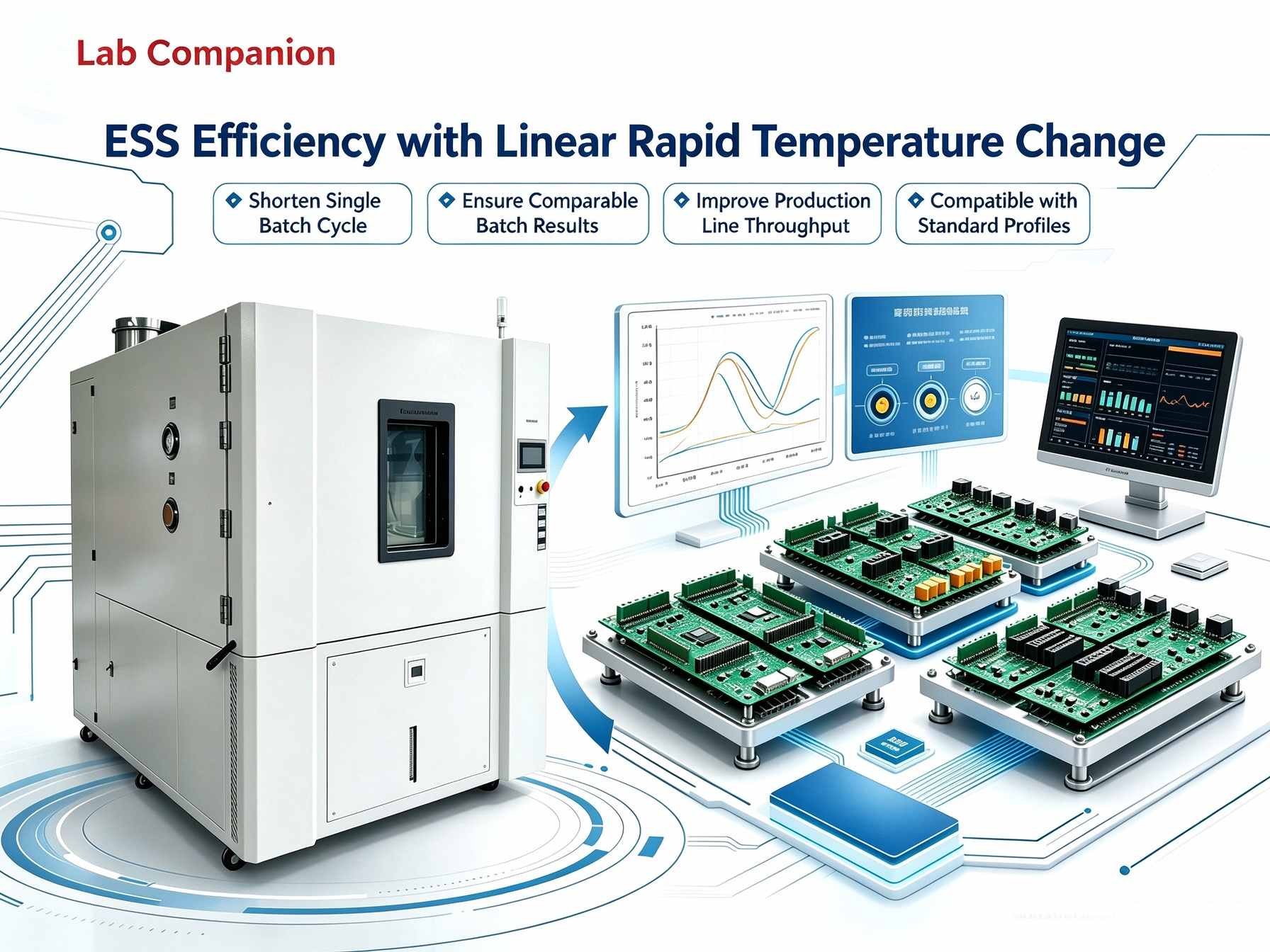
Reliability testing is no longer merely to verify whether a product “works”. Its core goal is to efficiently trigger and uncover latent defects. The rapid temperature change test chamber delivers controlled high temperature ramp rates to repeatedly apply thermal stress within a short cycle, cutting validation time and helping teams accelerate R&D iteration and production screening.
As a national high-tech enterprise rooted in Dongguan, Lab Companion specializes in the R&D and manufacturing of environmental reliability test equipment. Serving the electronics manufacturing sector including semiconductors, automotive electronics and optical communications, our rapid temperature change chambers are engineered for demanding thermal cycling assessments. This article explains ramp rate specifications, failure acceleration mechanisms, key equipment features and selection guidelines.
Temperature ramp rate refers to the speed of temperature rise or fall per unit time, measured in ℃/min. It is the core performance metric for rapid thermal cycling chambers. A higher ramp rate shortens each thermal cycle, allowing more cycles to be completed within the same test window and improving overall test throughput.
Lab Companion rapid temperature change test chambers offer linear ramp rates of 5℃/min, 10℃/min and 15℃/min:
Faster does not always mean better. Non-linear temperature transitions easily lead to temperature overshoot and internal condensation, introducing artificial stress that may damage precision components and invalidate test results. A reliable rapid thermal cycling chamber must deliver both fast response and stable, linear temperature control.
Electronic assemblies consist of multiple materials with different coefficients of thermal expansion (CTE). During rapid temperature swings, mismatched expansion and contraction generate concentrated thermal-mechanical stress at material interfaces. Higher ramp rates amplify this stress, revealing latent failures such as solder fatigue, package cracking and interface delamination at an earlier stage.
Engineers often evaluate multiple design variants within tight schedules. High ramp rates reduce cycle duration, enabling the required number of thermal cycles to finish sooner. This speeds up design comparison, optimization and new product launch.
In mass production screening, rapid thermal cycling cuts per-unit test time and increases factory throughput. The intensified thermal stress effectively weed out early failure units from batches, balancing screening effectiveness and production tact time.
Standard models cover -70℃ to +150℃, covering mainstream thermal cycling requirements for semiconductors, automotive electronics and optical communications, with extra margin available for highly accelerated stress tests.
Selectable linear rates of 5 / 10 / 15℃/min support compliance with industry standards or internal stress screening, reconciling test validity and productivity.
Temperature fluctuation ≤ ±0.3℃; temperature deviation ≤ ±2℃. Stable thermal field performance is maintained even under fast ramp conditions, ensuring comparable and repeatable test data across different batches and shifts.
Multi-layer racks support simultaneous testing of multiple samples to boost capacity. The system automatically logs temperature profiles and test records, satisfying digital quality control and traceability requirements.
First confirm the mandatory ramp rate stated in your test standard. For internal screening without fixed standards, higher ramp rates can be considered, with special attention to linear control performance.
The chamber working range must fully cover your test limits with sufficient margin. Precision specifications should guarantee consistent judgement. Lab Companion’s -70℃ ~ +150℃ range and tight control accuracy fit most common application scenarios.
While high ramp rates improve efficiency, excessive thermal stress may cause unintended damage to DUTs (devices under test). Select ramp rates and loading configurations according to material and structural characteristics. Custom solutions are available upon request.
Rapid thermal cycling tests often run continuously for extended periods. Equipment reliability and vendor support directly affect R&D and production schedules. Choose a manufacturer with mature production capability and a comprehensive service network to secure stable operation over the full equipment lifecycle.
A rapid temperature change test chamber is a powerful tool that turns controlled thermal stress into actionable reliability insights. Equipped with wide temperature coverage, adjustable linear ramp rates, high-precision control, batch testing and data traceability, Lab Companion rapid thermal cycling chambers help R&D and QA teams expose product weaknesses faster and streamline validation workflows. Moving forward, Lab Companion will keep focusing on environmental reliability testing, delivering robust equipment and professional service to help industries uphold strict quality standards.
 एक कहावत कहना


 IPv6 नेटवर्क समर्थित