बैनर
घर

तापमान आर्द्रता परीक्षण कक्ष

तापमान आर्द्रता परीक्षण कक्ष

  • Lab Companion Rapid Temperature Change Test Chamber: Long-Term Stability Ensures Server Reliability Data Credibility
    Sep 14, 2026
    1. The Overlooked Factor: Long-Term Stability of Test Equipment 1.1 Server Reliability Testing Demands Stable Endurance from Test Chambers High-power servers, especially AI training servers, require continuous 7×24 full-load operation in real scenarios. Large-model training tasks often run for days or weeks continuously. Long-duration thermal accumulation accelerates component aging and gradually introduces performance drift and hidden hardware failures. Therefore, server reliability validation cannot rely solely on short-term functional tests. It requires long-duration high-temperature aging tests to expose potential defects caused by sustained thermal stress. Global mainstream standards define clear testing requirements: • GB/T 2423.2-2018: Server motherboard high-temperature test range from 40℃ to 85℃, with test durations ranging from 24 hours to hundreds of hours. • GB/T 9813.3-2017: Server MTBF must exceed 10,000 hours, requiring 168 hours of continuous full-load aging without failure. These strict standards require environmental test equipment to maintain precise and stable conditions for hundreds of hours. In most procurement evaluations, buyers focus heavily on temperature range, ramp rate, and chamber volume, while easily ignoring long-term precision retention — the most critical factor that determines whether server test data is trustworthy. 1.2 How Equipment Drift Misleads Server Reliability Judgments After long-term cyclic operation, test chambers gradually generate parameter drift due to sensor aging, controller offset, and refrigeration system performance degradation. Subtle deviations in temperature accuracy, uniformity, and ramp rate will not trigger obvious equipment alarms, but they directly invalidate long-duration server test results. In high-power server full-load testing, even a 0.5℃ undetected temperature deviation can mask thermal design weaknesses. Poorly optimized server hardware may pass qualification tests mistakenly, bringing severe reliability risks to mass production and data center long-term operation. 2. Root Causes of Precision Degradation & Lab Companion Hardware Solutions 2.1 Three Core Causes of Long-Term Precision Loss Precision degradation is a cumulative aging effect, mainly derived from three systems: 1) Sensor drift Platinum sensors working repeatedly between -70℃ and +150℃ experience gradual resistance drift. Even minor deviations of 0.1℃–0.2℃ are enough to change the pass/fail judgment of high-precision server and semiconductor reliability tests. 2) Control algorithm offset Traditional fixed PID parameters are calibrated under no-load conditions. After long-term full-load server testing, original control parameters no longer match actual thermal loads, causing temperature overshoot, fluctuation, and unstable ramp speed. 3) Refrigeration and airflow decay Compressor efficiency attenuation, condenser dust accumulation, and fan wear gradually destroy internal temperature uniformity, resulting in inconsistent thermal stress for multi-server parallel testing. 2.2 Lab Companion Redundant Hardware Design for Long-Term Stability Lab Companion TC series rapid temperature change chambers adopt systematic anti-aging and redundant design to avoid long-term precision attenuation, fully adapting to server ultra-long-duration full-load tests. Dual-compressor redundant refrigeration system High-speed and low-temperature models are equipped with dual-compressor backup design (one working, one standby). The system automatically switches in case of single-unit failure, ensuring zero test interruption during hundreds of hours of continuous server aging tests. Dual compressors dynamically adjust load operation to avoid long-term full-load fatigue loss. Comprehensive component protection mechanism Soft start and soft stop systems eliminate instantaneous current impact. A minimum 3-minute compressor delay protection effectively extends service life. Built-in hot gas bypass valves stabilize pressure under variable loads and reduce frequent compressor start-stop fluctuations. Durable chamber and sealing structure Adopting SUS304 stainless steel inner chamber and high and low temperature resistant silicone seals, the equipment maintains stable physical performance after thousands of temperature cycles. The stable technical specifications cover -70℃ to +150℃, with temperature fluctuation ≤0.5℃ and temperature deviation within ±2℃. 3. Full-Lifecycle Stability Assurance: Factory Validation + On-Site Operation 3.1 Strict Factory Aging Validation Every Lab Companion chamber completes full-load aging before delivery to simulate the harshest customer working conditions. • New products pass 1,000+ hours reliability endurance tests • All finished products pass 72-hour continuous stable operation inspection Official test data proves that after simulated 3-year non-stop operation, with anti-fatigue structure and dynamic compensation algorithm: • Temperature ramp rate attenuation ≤5% (industry average: 15%) • Temperature accuracy attenuation ≤0.1℃ • Redundant system MTBF increases 2.5 times compared with traditional single-compressor systems 3.2 Industrial Long-Duration Operation Verification A leading automotive semiconductor packaging enterprise in East China deployed two Lab Companion HZ-ESS-800L rapid temperature change chambers (15℃/min ramp rate) for 7×24 batch cyclic reliability testing. With only 4-hour maintenance every two weeks, the units have achieved more than 5,000 hours of non-stop stable operation by Q1 2025. No unplanned shutdown occurred. Customer on-site logs show compressor current, exhaust pressure, and superheat parameters remain stable without long-term drift, fully proving long-term operational consistency under continuous heavy-load conditions. 3.3 Standardized Maintenance System to Sustain Long-Term Accuracy Lab Companion provides a standardized precision maintenance mechanism for long-term server testing scenarios. Users can perform quarterly sensor calibration with CNAS-certified tools or acquire official on-site calibration services. With standardized maintenance logs and annual professional inspection, the chamber consistently maintains high precision: temperature accuracy ±0.1℃~±0.3℃ and temperature uniformity ≤±0.5℃, fully meeting international reliability test standards. 4. Key Operation Guidelines for High-Power Server Testing To ensure credible and repeatable server long-duration test results, three key principles should be followed: 1) Quarterly sensor calibration Long-hour testing accumulates subtle sensor drift. Regular calibration eliminates system errors and ensures authentic thermal stress conditions. 2) Continuous operation log analysis Monitoring compressor status, pressure data, and temperature curve trends enables early detection of performance degradation and avoids unexpected test termination. 3) Full-load temperature uniformity verification High-power servers generate strong self-heating during full-load operation. Ensure chamber temperature uniformity remains stable under heavy load to guarantee consistent test conditions for single or multiple parallel server units. 5. Conclusion Server reliability testing aims to verify long-term operational stability under extreme and continuous thermal stress. The credibility of test results fundamentally depends on the long-term precision stability of the test chamber. Lab Companion rapid temperature change test chambers eliminate long-term drift, unexpected shutdowns, and data inconsistency through redundant hardware design, strict factory aging validation, and standardized lifecycle maintenance systems. The equipment fully supports conventional 48–72 hour server aging and hundreds-to-thousands of hours high-level reliability growth testing. As a professional environmental test equipment brand with 21 years of R&D and manufacturing experience, Lab Companion provides global customers with stable, repeatable, and traceable environmental test solutions, as well as full-cycle technical support from solution customization to after-sales service.
    और पढ़ें
  • Lab Companion Temperature Cycling Chamber: AEC-Q100 Qualification Test Practice for Automotive eMMC / UFS / SSD
    Sep 09, 2026
    1. Practical Requirements of AEC-Q100 Qualification for Automotive Storage 1.1 Market Entry Barriers for Automotive-Grade Storage Driven by vehicle intelligence and connectivity, automotive storage devices are seeing rising adoption. Infotainment systems, instrument clusters, T-BOX units, ADAS domain controllers and autonomous driving domain controllers all rely on eMMC, UFS or automotive SSD for data storage. Unlike consumer storage, automotive storage directly impacts driving safety and user experience, requiring far higher reliability. Tier 1 suppliers and OEMs universally mandate AEC-Q100 reliability qualification for storage components during part selection. Products without this qualification cannot be admitted into automotive supply chains. AEC-Q100 is an IC stress test specification defined by the Automotive Electronics Council. It specifies a full suite of reliability tests for automotive ICs before mass release, including temperature cycling, high-temperature operating life, high temperature humidity bias, ESD and latch-up. Temperature cycling is one of the core tests. It verifies package integrity and solder joint fatigue life under repeated thermal swings. For automotive storage, temperature cycling results determine whether a product can pass AEC-Q100 and be listed in OEM approved vendor lists. 1.2 Position of AEC-Q100 in Storage Component Qualification AEC-Q100 classifies devices into four temperature grades based on operating temperature ranges for different vehicle applications: • Grade 3: 0℃ to +85℃ • Grade 2: -40℃ to +105℃ • Grade 1: -40℃ to +125℃ • Grade 0: -40℃ to +150℃ Grade 3 applies to less demanding in-cabin infotainment systems. Grade 2 covers body control, infotainment and T-BOX, which represent most automotive electronic modules. Grade 1 targets harsh environments near engine bays and ADAS domain controllers. Grade 0 serves the most demanding engine and transmission control units. For automotive storage, Grade 2 and Grade 1 are the mainstream qualification levels. Storage for infotainment and body control typically follows Grade 2. ADAS and autonomous driving storage, mounted close to engine compartments or requiring higher reliability margin, usually requires Grade 1. Temperature cycling is a mandatory AEC-Q100 test. Test conditions vary by grade: Grade 2 uses -40℃ to +105℃; Grade 1 uses -40℃ to +125℃. Both require a minimum of 500 cycles. 2. Comparison of Temperature Cycling Conditions: Grade 1 vs Grade 2 2.1 Grade 2: -40℃ ~ +105℃ Condition Breakdown Grade 2 temperature cycling spans -40℃ to +105℃ with a 145℃ delta. This profile simulates extreme real-world cabin conditions: vehicles parked outdoors in cold northern winters may drop near -40℃; after summer sun exposure, electronics behind dashboards can exceed 100℃. Each cycle consists of four phases: ramp from -40℃ to +105℃ (typically 10℃/min to 15℃/min), dwell at +105℃ for ≥10 minutes to stabilize internal sample temperature, ramp down from +105℃ to -40℃, then dwell at -40℃ for ≥10 minutes. One full cycle takes roughly 40–60 minutes. 500 cycles require continuous chamber operation for 330–500 hours (14–21 days). Samples remain powered during cycling, with real-time monitoring of read/write performance and key parameters. 2.2 Grade 1: -40℃ ~ +125℃ Condition Breakdown Grade 1 uses -40℃ to +125℃, creating a 165℃ temperature delta. Compared with Grade 2, the upper temperature limit rises by 20℃ and the thermal delta increases by 20℃. This profile targets storage mounted near engine bays and ADAS controllers, where component temperatures can exceed 105℃ and reach above 120℃ under heavy vehicle load. Raising the maximum temperature to 125℃ substantially increases stress on storage devices: 1. Larger thermal expansion mismatch across different materials creates stronger thermo-mechanical stress on solder joints and package interfaces, accelerating defect exposure. 2. 125℃ approaches the glass transition and creep range of molding compounds and solders, degrading mechanical properties and raising risks of solder fatigue and package delamination. 3. High temperatures accelerate NAND Flash data retention degradation, imposing stricter reliability requirements on storage media. The cycle sequence matches Grade 1 and Grade 2. However, the wider temperature delta extends ramp times. One Grade 1 cycle lasts 50–70 minutes. Completing 500 cycles requires continuous operation for 420–580 hours (18–24 days). 2.3 Test Differences and Selection Logic The core distinction between Grade 1 and Grade 2 lies in maximum temperature and thermal delta, which affects three areas: thermal stress magnitude, total test duration and chamber requirements. Grade 1 generates higher thermal stress and accelerates latent failure modes. Its total test time is 20–30% longer. The 125℃ plateau demands superior heating performance and temperature stability without overshoot. When defining qualification strategy, select the grade based on end application. Grade 2 is sufficient for infotainment, body control and T-BOX. Grade 1 is recommended for ADAS, autonomous driving controllers, engine-bay adjacent hardware, global markets or applications requiring extra reliability margin. A Grade 1 qualified component is backward compatible with Grade 2 use cases, while Grade 2 parts cannot be deployed in Grade 1 environments. Many manufacturers choose Grade 1 qualification upfront to broaden market coverage. 3. Full Workflow of Temperature Cycling Test 3.1 Pre-test: Sample Preparation and Initial Characterization AEC-Q100 temperature cycling includes three phases: pre-test preparation, test execution and post-test evaluation. Pre-test work ensures consistent sample condition and complete baseline data. A minimum of 77 units are randomly sampled from one batch (exact quantity depends on test plan and acceptance criteria). All samples undergo visual inspection to rule out physical damage, package defects or marking issues. Initial electrical characterization is then performed and recorded: functional tests (read/write, erase, bad block management), performance tests (sequential read/write speed, random IOPS), and health checks including SMART attributes, bad block count, wear leveling and initial error rates. Baseline data serves as reference for post-test comparison. Any meaningful parameter shift must be documented and analyzed. Only samples passing initial inspection are loaded into the chamber. Sample loading rules: distribute samples evenly across shelves to avoid localized thermal accumulation. Mount each unit on sockets or burn-in boards connected to external test hosts for live power monitoring. Maintain sufficient air gaps between samples to prevent airflow blockage and temperature non-uniformity. 3.2 Test Execution: Program Setup, Live Monitoring and Cycle Counting During execution, the chamber controller runs a programmed thermal profile: start temperature, ramp rate, high dwell setpoint and duration, low dwell setpoint and duration, plus target cycle count. Grade 2 is programmed for -40℃ / +105℃; Grade 1 for -40℃ / +125℃. Ramp rates are set between 10℃/min and 15℃/min, with minimum 10-minute dwells at extremes and 500 total cycles. Once started, the chamber runs automatically and continuously logs thermal profiles. External test hosts maintain power to DUTs and collect data every 5–10 minutes. Monitored items include power status, read/write integrity, disk dropouts, communication interruptions and abnormal error growth. Critical events such as DUT dropout are timestamped with cycle number. Cycle counting adopts dual control: automatic chamber logging plus daily manual cross-check against temperature curves to confirm validity. If tests stop due to power loss, chamber fault or temperature alarm, engineers review logs and thermal history to decide whether partial cycles count toward the total. AEC-Q100 defines clear rules for interrupted tests; all decisions must follow the standard. 3.3 Post-test: Final Characterization, Failure Analysis and Report Generation After finishing 500 cycles, samples are removed and stabilized for ≥2 hours under standard ambient conditions (15℃–35℃, 25–75% RH) before final testing. Final tests repeat the full initial inspection suite: visual check, functional, performance and health assessment. Acceptance criteria: no visible cracking, deformation or package damage; all read/write functions remain operational without dropouts or communication failures; performance degradation stays within product specification limits; bad block and error count increases remain within acceptable thresholds. Any failed unit triggers failure investigation. AEC-Q100 uses LTPD sampling to determine batch pass/fail based on failure tally. Failed samples go through failure analysis: SAM scanning for package delamination, X-ray inspection for solder cracking, cross-sectioning to observe crack morphology, and electrical fault isolation. FA findings feed design and process improvements. The final test report contains standard reference, test profile, chamber ID/calibration status, sample batch/serial numbers, baseline data, continuous temperature logs, cycle records, real-time monitoring logs, post-test results and failure analysis conclusions. Reports require sign-off by test and review engineers as supporting documentation for AEC-Q100 certification. 4. AEC-Q100 Compliance Capabilities of Lab Companion Temperature Cycling Chambers 4.1 Temperature Range and Accuracy Compliance Lab Companion temperature cycling chambers cover -70℃ ~ +150℃, fully satisfying AEC-Q100 Grade 2 (-40℃ to +105℃) and Grade 1 (-40℃ to +125℃) requirements with ample safety margin. The system maintains stable long-run operation at 125℃ without thermal drift. Performance specifications: temperature fluctuation ≤ ±0.5℃, temperature uniformity ≤2.0℃, temperature deviation ±2.0℃, exceeding GB/T 5170 requirements. AEC-Q100 requires consistent thermal stress across all DUTs. Lab Companion’s ≤2.0℃ uniformity ensures all automotive storage samples experience equivalent thermal loading over 500 cycles, delivering statistically valid test results. Linear ramp rates are configurable from 5℃/min to 25℃/min to precisely replicate AEC-Q100 thermal profiles. 4.2 Long-duration Stability and Data Traceability AEC-Q100 temperature cycling demands uninterrupted operation for 14–24 days. Lab Companion chambers use premium brand compressors and refrigeration components with multi-layer protection: over-temperature, compressor overload and phase-loss protection. Every unit undergoes a minimum 48-hour continuous run-in test before shipment to validate refrigeration and control reliability. Traceability is mandatory for AEC-Q100 audits. The touch controller automatically records temperature curves, cycle counters, alarms and runtime logs. Data can be exported via USB as CSV or PDF files for report archiving. Complete thermal logs serve as objective evidence during certification audits and meet traceability requirements. 4.3 Calibration at Dongguan Factory & Global Service Support Each chamber is assembled and calibrated at the Dongguan manufacturing site. Factory validation includes ramp rate verification, 9-point temperature mapping, extreme setpoint stability testing and continuous runtime validation. For automotive storage customers, pre-run validation for Grade 1 or Grade 2 profiles can be performed to confirm performance under your target test conditions. Delivery includes calibration certificates and validation reports, ready for lab system audits and AEC-Q100 on-site reviews. Our global service network delivers installation, commissioning, periodic calibration and on-site repair. Automotive qualification schedules are tight; rapid service response minimizes downtime caused by equipment faults. Annual maintenance is recommended, including refrigeration inspection, electrical tightening, thermal field recalibration and consumable replacement to sustain accuracy for years of AEC-Q100 testing. 5. Common Issues in AEC-Q100 Qualification and Mitigation 5.1 Test Interruption and Cycle Recounting Power outages, equipment faults or temperature alarms may halt cycling. AEC-Q100 interruption rules: if the stop occurs during temperature dwell, lasts ≤30 minutes and sample temperature remains close to setpoint, completed cycles remain valid. If interruption happens during ramp-up/ramp-down, or temperature deviates significantly, the incomplete cycle is discarded and valid counts must be re-evaluated against thermal logs. Mitigation: deploy UPS backup for power resilience; implement scheduled preventive maintenance; review temperature profiles and chamber status daily; preserve full logs after any outage and consult certification bodies when judging cycle validity. 5.2 Temperature Non-uniformity and Sample-to-sample Variation Poor airflow from overloading, accumulated dust or expired calibration creates uneven thermal distribution. Symptoms include large failure-rate variance across positions in one chamber and inconsistent results across batches. Mitigation: follow sample loading guidelines and preserve airflow channels; regularly clean condensers and air ducts; perform 9-point thermal mapping every 6–12 months to maintain ≤2.0℃ uniformity; mark poor-uniformity zones and avoid placing critical qualification samples there; arrange on-site service for airflow tuning and recalibration when needed. 5.3 Non-compliant Test Reports Auditors frequently reject incomplete reports due to missing ramp rates/dwell times, discontinuous temperature logs, unclear sample serial number traceability, superficial failure analysis or incomplete approval signatures. Mitigation: adopt standardized AEC-Q100 report templates covering all mandatory fields; export native chamber logs to avoid manual transcription errors; maintain sample traceability linking serial numbers, baseline data, runtime logs and post-test results; document full failure analysis for all rejected units; enforce three-level sign-off (test engineer, reviewer, approver). 6. Conclusion AEC-Q100 temperature cycling is a gatekeeper for automotive eMMC, UFS and SSD entering OEM supply chains. The difference between Grade 2 and Grade 1 defines thermal stress intensity, test duration and chamber requirements. Rigorous control across the full test lifecycle — sample preparation, in-test monitoring, post-test characterization and reporting — directly determines qualification success. Lab Companion temperature cycling chambers deliver wide temperature range, precise thermal control, reliable long-run operation and full data traceability, fully supporting AEC-Q100 Grade 1 and Grade 2 qualification for automotive storage. Backed by factory calibration in Dongguan and worldwide after-sales support, Lab Companion provides end-to-end solutions: chamber selection, profile setup and test execution support. We help storage manufacturers complete AEC-Q100 qualification smoothly and gain access to automotive supply chains.
    और पढ़ें
  • Lab Companion Temperature Test Chamber: High-Temperature Reliability Testing Practice for Data Center Servers and Multi-Bay NAS
    Sep 05, 2026
    1. Necessity of Full-Server Temperature Cycling Testing 1.1 Component-Level Qualification Does Not Equal System-Level Reliability CPU, memory, SSD, PSU and other individual server components are factory-certified with clear temperature tolerances and reliability ratings. However, once integrated into a complete server or NAS system, the actual internal thermal environment changes significantly. System chassis airflow layout, mutual heat interference between densely arranged components, and dynamic fan speed adjustment often create local hotspots. These factors may push component operating temperatures beyond their rated specifications. For this reason, real full-system temperature testing under powered and loaded conditions is mandatory. Component datasheets and software thermal simulation cannot replace physical environmental chamber verification, which is essential to validate coordinated system stability. 1.2 Coupled Thermal Effects in Server and NAS Chassis Under full load, server CPUs and GPUs generate intense heat, which raises the ambient air temperature inside the chassis. Heated airflow passes through hard drives, memory modules and power units, elevating the overall operating temperature of the entire system. This thermal coupling effect is more severe on multi-bay NAS devices, where tightly packed HDDs/SSDs amplify heat accumulation during continuous write workloads. High-temperature testing simulates extreme data center failure scenarios, including air conditioning outage and rack inlet temperature surge, with a test range of +40℃ to +55℃. During testing, engineers monitor real-time temperature readings of all key components to detect thermal throttling, overheating protection, performance degradation or system errors. For multi-bay NAS units, special attention is paid to write amplification and SMART parameter variations under high-temperature high-load conditions. 2. Core High/Low Temperature Test Items for Servers and NAS 2.1 Long-Duration High-Temperature Burn-In Test High-temperature continuous burn-in is the foundation of server system reliability validation. The full system is placed in a constant temperature environment of +40℃ to +55℃ and runs sustained CPU, RAM and disk stress tests to simulate maximum operational load. Standard test duration ranges from 48 to 72 hours. Key monitoring metrics include component temperature, power consumption, fan speed and system logs. Pass criteria cover no system crash, no unexpected reboot, no hardware error logs, no excessive thermal throttling, and no degradation in disk health status. For rack-mount servers, inlet/outlet temperature difference and airflow efficiency are also verified to eliminate thermal dead zones and short-circuit airflow risks. 2.2 Multi-Bay NAS Write Amplification and SMART Monitoring Multi-bay NAS devices with 4 to 24+ drives operate under RAID-based continuous write workloads, resulting in concentrated and mutually superimposed heat generation. High ambient temperature significantly increases SSD write amplification, accelerating NAND flash aging and shortening service life. Therefore, NAS high-temperature testing focuses on two critical indicators: write amplification factor and drive SMART health status, including disk temperature, bad block count, wear leveling and unexpected power loss records. Lab Companion large-capacity temperature chambers can accommodate complete NAS units and reserve external cable ports for real-time drive data collection. The system automatically records full-process temperature curves and SMART changes, providing complete and traceable test data for chassis thermal design optimization and fan control strategy iteration. 2.3 Low-Temperature Startup and Gradual Temperature Adaptation Test Although data centers maintain constant indoor temperature, servers and NAS devices are exposed to low temperatures during transportation, warehousing and unexpected facility downtime. Low-temperature startup testing is conducted between 0℃ and -20℃. After sufficient temperature stabilization, the system is powered on to verify normal BIOS initialization, OS booting, RAID identification and disk mounting. Gradual temperature variation testing simulates slow data center temperature fluctuations. The chamber temperature rises or falls stepwise with staged load operation, to verify fan response accuracy, system performance stability and thermal management adaptability. This effectively detects hysteresis or over-adjustment defects in firmware thermal control logic. 2.4 International Compliance Standards All testing procedures comply with globally recognized standards:GB/T 2423 series, IEC 60068-2-1 (low temperature) and IEC 60068-2-2 (high temperature). Lab Companion test chambers are manufactured in accordance with GB/T 10592-2023, ensuring qualified temperature fluctuation, uniformity and deviation indicators to guarantee repeatable and credible test results. 3. Lab Companion Chamber Selection & Technical Advantages 3.1 Full Capacity Range for All Server and NAS Form Factors Lab Companion provides a complete volume lineup: 34L / 64L / 100L / 180L / 340L / 600L / 1000L / 1500L, covering all mainstream device sizes. 1U/2U rack servers fit 340L+ models; 4U/5U tower servers and multi-bay NAS recommend 600L+ chambers; full rack testing supports 1000L+ or customized walk-in solutions. Large-capacity models adopt enhanced heating and refrigeration systems to maintain stable temperature even with high-thermal-capacity full-system samples. The SUS304 stainless steel inner chamber features high load-bearing capacity and customizable layered brackets to fit server and NAS dimensions. 3.2 Ultra-Wide Temperature Range and High Precision Control Standard temperature coverage spans-70℃ to +150℃, with optional customized low-temperature limits (-20℃ / -40℃ / -60℃), fully covering all conventional and extreme temperature test requirements for data center hardware. Precision performance: temperature fluctuation ≤±0.5℃, temperature deviation ±2.0℃, temperature uniformity ≤2.0℃. Equipped with BTHC balanced temperature control system, the chamber realizes dynamic hot-cold balance, avoiding temperature overshoot and oscillation. Stable and uniform internal temperature ensures consistent and repeatable test data without abnormal fan speed jitter or system performance fluctuation. 3.3 Gentle Temperature Ramp Rate and Optimized Airflow Design Standard ramp rates of 1℃/min and 3℃/min support gradual temperature change testing, which simulates real data center temperature drift. Compared with rapid thermal shock chambers, the gentle temperature transition better verifies the accuracy and stability of the device’s native thermal management algorithm. The forced convection airflow design realizes full-chamber uniform temperature distribution. Air circulation and return pathways eliminate internal thermal dead zones. Test airflow direction can be adjusted to match actual rack inlet/outlet airflow, ensuring test scenarios highly consistent with real operating environments. 4. Global Delivery & After-Sales Service Policy (Overseas) 4.1 R&D and Customization Capabilities Lab Companion is a national high-tech enterprise with 21 years of experience in environmental testing equipment R&D and manufacturing. The Dongguan production base supports standard mass production and non-standard customization, including oversized chambers, reserved test wiring holes, multi-channel data acquisition and custom load-bearing fixtures to meet personalized server and NAS testing demands. All equipment undergoes strict factory calibration and full-temperature-domain uniformity testing before delivery to ensure stable and accurate performance under formal test conditions. 4.2 Overseas After-Sales Service Mechanism Note for overseas customers: On-site door-to-door service is not available in overseas regions. To guarantee stable equipment operation for global users, Lab Companion provides a standardized overseas after-sales system: free genuine spare parts supply within the warranty period + full-cycle online technical guidance. Our professional overseas technical team supports remote equipment commissioning, operational training, fault diagnosis and troubleshooting guidance. Users can complete daily calibration, routine maintenance and minor fault recovery under online instructions, effectively avoiding long downtime. 4.9 Global Application Cases Lab Companion environmental test chambers are widely adopted by global enterprises, university laboratories and research institutions in server, NAS, new energy and semiconductor industries. Overseas and domestic clients include power research institutes, automotive electronic enterprises and top universities. Field feedback verifies that Lab Companion large-capacity chambers maintain excellent temperature stability even with full server/NAS loads. The programmable controller stores multiple test recipes for one-click switching of different test standards. For multi-bay NAS high-temperature testing, the equipment accurately captures long-duration write performance and disk health data, helping clients optimize thermal design and improve product reliability in high-temperature data center environments. 5. Conclusion As global data center computing density continues to rise, full-system temperature reliability has become a core indicator of data center hardware quality. Full-server and NAS high/low temperature testing effectively verifies coordinated thermal stability under real loaded conditions, which cannot be replaced by single-component testing. Lab Companion test chambers deliver reliable hardware support for data center hardware reliability verification through full-size coverage, ultra-wide and high-precision temperature control, and industry-matched airflow simulation. With strong customization capability and professional overseas remote after-sales support, Lab Companion provides global clients with a complete solution covering model selection, customized manufacturing, remote commissioning and lifelong technical support. Stable and standardized full-system environmental testing helps global hardware manufacturers optimize thermal design, improve environmental adaptability, and reduce field failure risks, empowering high-quality and reliable development of global data center infrastructure.
    और पढ़ें
  • Lab Companion Temperature Test Chambers: Full-Lifecycle SSD Testing Solutions from R&D to Mass Production Screening
    Sep 04, 2026
    1. SSD Reliability Testing: More Than Basic Temperature Simulation Solid-state drives (SSDs) undergo rigorous environmental reliability validation throughout their entire journey from prototype design to mass delivery. Every development stage demands distinct testing standards: performance boundary verification in R&D, standard compliance validation in design verification, process stability evaluation during pilot production, and early failure screening in mass manufacturing. Each phase requires different equipment capabilities. R&D requires ultra-wide temperature range and high-precision control to capture accurate limit performance data. Design verification prioritizes test repeatability and consistency. Pilot production needs scalable batch testing capacity. Mass production demands high throughput, automated operation, and long-term stable runtime performance. A single versatile test chamber that covers the full development lifecycle greatly improves testing efficiency and reduces equipment investment costs. Established in 2005, Lab Companion is a national high-tech enterprise and specialized & sophisticated manufacturer based in Dongguan, China. With 20+ years of focus on environmental reliability test equipment, our PS series temperature and humidity chambers and TC series rapid thermal cycling chambers serve as one-stop testing platforms for consumer and enterprise-grade SSD full-lifecycle validation. 2. R&D Phase: Performance Boundary Exploration Under Extreme Conditions During SSD prototype development, engineers must verify the operational stability of main controllers, NAND flash particles, and complete drives across diverse temperature environments. Small-batch engineering samples require wide-spectrum temperature testing with strict precision requirements. Lab Companion PS series thermal test chambers feature a broad temperature range of-70℃ to +150℃. This fully covers consumer SSD testing scenarios from -10℃ cold startup to +70℃ high-temperature continuous read-write operation. It also meets enterprise SSD thermal cycling standards (40℃ to 85℃) and reserves sufficient margin for vehicle-grade SSD extreme validation (-40℃ to 125℃). The chamber delivers industry-leading precision: temperature fluctuation ≤±0.5℃, temperature deviation ≤±2.0℃, and temperature uniformity ≤±2.0℃. Compliant with the GB/T 10592-2023 international equipment standard, it ensures uniform environmental stress across all sample positions and highly repeatable test results. For advanced R&D validation, Lab Companion chambers support docking with Advantest and Teradyne IC test systems to verify core chip functionality under extreme temperatures. External T/K-type thermocouples accurately monitor real sample surface temperatures, ensuring precise thermal soak validation. 3. DVT Phase: Standard Compliance and Repeatable Validation In the Design Verification Test (DVT) stage, SSD products must comply with global JEDEC industry standards, includingJESD218 and JESD22-A104. Consumer SSDs undergo 25℃ to 70℃ thermal cycling to simulate daily usage and verify stability and data integrity. Enterprise SSDs require 40℃ to 85℃ cycling with 100% random read-write load to validate QoS latency consistency under high-load operation. DVT testing requires outstanding equipment repeatability to eliminate environmental errors from batch-to-batch results. Lab Companion’s stable temperature control ensures identical test conditions for every cycle. The programmable controller stores multiple custom test profiles for automatic cyclic operation, minimizing human-induced variables. For long-duration durability tests requiring hundreds or thousands of thermal cycles, Lab Companion chambers support 1000+ hours of continuous stable operation. Built-in UPS power backup and breakpoint resume functions automatically restore testing after unexpected power outages, preventing sample damage and data loss. 4. PVT Phase: Mass Production Process Stability Verification During Pilot Verification Test (PVT), manufacturers validate mass-production process consistency via medium-batch sample testing. Reliable batch thermal cycling results are critical for confirming production yield stability. Lab Companion chambers adopt a flexible multi-layer tray structure adaptable to various SSD dimensions. Standard volume options range from 80L to 1000L, with custom capacities from 80L to 8000L available to suit lab-scale R&D and medium-volume pilot testing. Each SSD sample supports independent power supply and individual data monitoring. The system automatically records full-test data including temperature curves, ramp rates, and dwell time, and generates standardized pass/fail test reports. All data can be integrated into factory quality traceability systems to support mass production validation decisions. 5. Mass Production Phase: High-Efficiency Stress Screening and Early Failure Elimination High-volume SSD mass production requires fast, cost-effective reliability screening to eliminate early failed units without compromising throughput. Lab Companion ESS Environmental Stress Screening Chambers are purpose-built for production-line accelerated testing. The ESS series provides adjustable thermal ramp rates of 5℃/min to 15℃/min within -55℃ to +85℃, with temperature uniformity ≤2℃. Pre-configured standard test profiles allow one-click switching between consumer and enterprise SSD screening procedures. The multi-layer tray design enables high-density simultaneous testing of hundreds of SSDs. Equipped with independent power and data acquisition channels, the system supports 24/7 unattended automated operation, significantly improving production-line testing efficiency. In practical industrial applications, a Tier 1 automotive supplier reduced SSD early failure rate from 800ppm to below 200ppm after deploying the Lab Companion TC-408 rapid thermal cycling chamber (10℃/min ramp rate), demonstrating reliable mass-screening performance. 6. Full-Cycle Safety Protection and Complete Data Traceability High-value SSD prototypes and mass-production components require rigorous safety protection and full data traceability throughout testing. Lab Companion chambers adopt multi-level safety mechanisms: independent mechanical over-temperature protection (hardware-level cutoff unaffected by software failures), compressor over-pressure/overload/delay startup protection, dual over-temperature protection for heating systems, and comprehensive electrical protection against phase loss, leakage, and grounding faults. These designs fully protect test samples from damage. For quality management, the system supports batch code scanning and full-process data archiving. All temperature curves, test parameters, and operation logs are permanently traceable. Intelligent fault diagnosis displays error codes and troubleshooting steps directly on the screen, with remote alarm notifications available via mobile and PC terminals for unattended operation security. 7. Conclusion Reliability temperature testing runs through the entire SSD lifecycle: R&D boundary exploration, DVT standard compliance verification, PVT process validation, and mass production failure screening. With -70℃ to +150℃ ultra-wide temperature range, ±0.5℃ precise temperature control, excellent temperature uniformity, and scalable batch testing capability, Lab Companion PS and TC series chambers deliver a fully compatible solution for SSD industry from laboratory R&D to factory mass production. Serving over 3000 global manufacturers, research institutions and testing labs, Lab Companion has proven its capability as a reliable full-lifecycle testing partner for semiconductor storage reliability validation.
    और पढ़ें
  • Lab Companion MES/EAP-Enabled Temperature Test Chambers: Quantifiable Improvements in Efficiency, Cost, Quality and Factory Management Lab Companion MES/EAP-Enabled Temperature Test Chambers: Quantifiable Improvements in Efficiency, Cost, Quality and Factory Management
    Sep 02, 2026
    1. Overview: Turning Reliability Testing from “Cost Center” into “Data Asset” In semiconductor, automotive electronics, new energy and optical communication manufacturing, environmental reliability testing has long been treated as a necessary cost. Traditional temperature chambers operate as standalone devices. Test data is stored locally, isolated from factory systems, and requires heavy manual work to organize and verify. Lab Companion network-enabled temperature and thermal cycling chambers solve this industry pain point. By supporting MES and EAP system integration, our testing equipment becomes a connected node on the smart production line. All test data is digitized, traceable and automatically synchronized to factory management systems. The upgrade delivers clear, quantifiable improvements in productivity, operational cost, quality compliance and factory transparency. 2. Efficiency Gains: Automate Manual Workflows Most testing bottlenecks are not caused by device performance, but by repetitive manual operations: recipe setup, batch entry, data logging and report generation. Lab Companion smart chambers eliminate these inefficient workflows. 2.1 One-click standard test recipes Equipped with an industrial H-Touch controller, the chamber supports up to 1200 programmable cycling segments. Industry-standard test profiles including JESD22-A104, JESD22-A106B and AEC-Q100 are preloaded and available for one-click activation. Manufacturers no longer need manual parameter configuration during product changeover. It eliminates human setup errors, avoids invalid testing and shortens setup time significantly. 2.2 Auto batch logging and PDF report output The device supports barcode batch scanning for automatic product binding. Once a test completes, the system automatically generates a standardized PDF report containing temperature curves, ramp rates, dwell time and pass/fail results. All data is uploaded directly to MES. This replaces manual report sorting, which traditionally takes around 40 minutes per batch, saving substantial labor hours for mass production. 2.3 Local real-time data recording and direct USB export Real-time test curves are automatically saved locally. Operators can export complete historical data via USB without extra host software. Data retrieval and technical review become fast and convenient. 3. Cost Reduction: Lower Energy Consumption & Maintenance Cost For 24/7 continuous environmental screening, energy consumption and equipment maintenance are the two largest operational costs. Lab Companion optimizes both through intelligent control and upgraded hardware. 3.1 AI energy-saving control, 28%–38% power reduction Traditional on-off compressors waste massive energy during stable temperature holding. Lab Companion chambers adopt variable-frequency compressors + electronic expansion valves, paired with self-developed Q8 intelligent control algorithm. The system dynamically adjusts compressor frequency, heating output and airflow based on real-time load and ambient conditions. Temperature overshoot is controlled below 0.8%. Compared with conventional chambers, overall energy consumption drops by 28%–38%, and steady-state power saving exceeds 40%. 3.2 AI predictive fault diagnosis, 70% fewer failures Traditional maintenance is passive and reactive. Lab Companion’s real-time component monitoring system predicts potential failures in advance. Data shows the intelligent warning system reduces equipment failure rate by 70% and cuts maintenance costs by 30%. The built-in 600,000 offline data storage points ensure zero data loss during network disconnection. Data will be auto-resynchronized once the network recovers, preventing rework caused by missing records. 4. Quality Upgrade: Full Lifecycle Traceability & Compliance For high-precision industries, reliable, auditable and reproducible test data is the core of quality certification and supply-chain compliance. 4.1 Complete data chain from batch to final judgment Via OPC UA and Modbus TCP protocols, the chamber synchronizes all test parameters to MES in real time, including temperature profiles, cycling speed, holding duration and pass/fail status. It builds a full traceability chain: Batch — Device — Recipe — Curve — Test Result. 4.2 No manual filling for audit and certification All data is automatically archived with unified standards. No manual spreadsheet adjustment is required before customer audits or industry certification reviews. It greatly reduces compliance risks and preparation workload. 4.3 Stable data recording for long-duration tests With 600,000 offline storage records, the system supports ultra-long aging and cycling tests for optical components and new energy cells. Continuous data integrity is guaranteed even under unstable network conditions. 5. Smart Factory Management: Transparent & Remote Operation Standalone test chambers create “black boxes” on production lines. Lab Companion networking transforms discrete testing equipment into visible, manageable production assets. 5.1 Real-time test progress visualization MES management terminals can monitor real-time status of all connected chambers, including running recipes, test progress and completion results. Production supervisors can schedule tasks accurately and optimize equipment utilization. 5.2 Full remote monitoring & control Based on web-based Q8 control system, engineers can remotely view temperature curves, adjust parameters, start/stop tests and check historical records via PC or mobile devices. On-site attendance is no longer mandatory, which greatly improves management efficiency for multi-site factories. 5.3 Instant alarm for abnormal status System errors and parameter deviations trigger real-time alerts. Maintenance teams can respond rapidly to minimize downtime and ensure continuous production screening. 6. Core Specifications of Lab Companion Networked Test Chambers • Product Series: TC/ESS Rapid Temperature Change Chamber, TS/PS Temperature & Humidity Chamber, OVEN High-Temperature Aging Chamber • Temperature Range: -70℃ ~ +150℃; max +300℃ for high-temp models • Temperature Accuracy: Fluctuation ±0.5℃, Deviation ±2.0℃, Uniformity ≤2.0℃ • Temperature Ramp Rate: 5℃/min ~ 25℃/min optional • Capacity Range: 80L ~ 2000L full coverage • Standard Interface: RS485, Ethernet • Industrial Protocols: OPC UA / Modbus TCP optional; SECS/GEM customizable for semiconductor FAB EAP integration • Smart Functions: 1200-step programmable recipes, 600,000 offline data storage, AI predictive maintenance, remote control 7. Conclusion: Measurable Benefits for Smart Manufacturing Lab Companion MES/EAP-enabled environmental test chambers deliver fully verified, data-driven upgrades for modern factories: • Higher Efficiency: Automated recipes, auto-reporting and barcode tracing eliminate repetitive manual work and human errors. • Lower OPEX: 28%–38% energy saving and 30% less maintenance cost bring long-term operational benefits. • Reliable Quality: Full-process traceable data meets global automotive, semiconductor and new energy certification standards. • Digital Management: Transparent, remote and intelligent operation fits Industry 4.0 smart factory requirements. Proven in semiconductor, automotive electronics, optical communication and new energy production lines, Lab Companion networked testing solutions help global manufacturers turn reliability testing from a pure cost center into a valuable, data-driven quality control asset.
    और पढ़ें
  • MES/EAP Integrated Test Chamber vs Traditional Chamber | Lab Companion Procurement Guide MES/EAP Integrated Test Chamber vs Traditional Chamber | Lab Companion Procurement Guide
    Sep 01, 2026
    How to Choose Between Two Test Chambers With Similar Core Parameters? Most manufacturers select environmental test chambers based on core hardware parameters: temperature range, temperature change rate, and temperature control accuracy. On paper, two units may look identical. However, significant gaps emerge during long-term production operation. The difference is not in whether the machine can complete a test, but in how test data is managed, how equipment is maintained, and how the unit integrates into your smart production line. One device supports automatic system data uploads and early fault alerts; the other relies on manual logging and passive maintenance. Lab Companion, a professional manufacturer of environmental reliability test equipment founded in 2005, provides both traditional standalone test chambers and smart MES/EAP network-connected test chambers. Below is a professional comparison from four critical dimensions for overseas enterprise procurement and production upgrade reference. 1. Data Collection: Manual Logging vs Real-Time Automatic Upload Traditional Test Chamber All temperature curves and test data are only displayed on the local screen. Operators must record data manually or export records via USB and input them into Excel spreadsheets manually. For multi-device and multi-batch simultaneous testing, manual workload rises sharply. Data cannot be synchronized in real time, and historical test records are easily lost during long-term production, resulting in incomplete and unreliable test data. Lab Companion Network-Connected Test Chamber Equipped with standard RS485 and Ethernet ports, supporting mainstream industrial protocols including OPC UA and Modbus TCP. Real-time data such as temperature curves, actual temperature change rates, dwell time, and pass/fail judgments can be automatically uploaded to the MES system. The device supports 600,000 offline data storage records. When the network is disconnected, data is cached locally and automatically supplemented after network recovery, ensuring zero data loss. It also reserves a USB export channel to meet flexible on-site data retrieval needs. 2. Data Traceability: Scattered Paper Records vs Complete Digital Archives Traditional Test Chamber Test reports are compiled manually. Batch information, equipment numbers, test programs, and test results are associated through manual spreadsheets. Long-term operation leads to missing records and inconsistent data standards. Quality audits, batch tracing, and problem troubleshooting require massive time and labor costs to sort out original data. Lab Companion Network-Connected Test Chamber Support scan-code batch entry. After testing is completed, the system automatically generates a standard PDF test report with pass/fail results. It forms a closed-loop digital traceability chain: Product Batch — Equipment ID — Test Program — Temperature Curve — Test Judgment. All data is synchronized to the MES system uniformly. Original test records can be retrieved instantly, greatly improving the efficiency of quality inspection, factory audit, and after-sales problem analysis. 3. Equipment Maintenance: Passive Repair vs Intelligent Early Warning & Remote Monitoring Traditional Test Chamber Adopt passive maintenance mode. Equipment failures can only be discovered after shutdown and abnormality occurs. Sudden equipment downtime will interrupt the entire test process, bringing additional losses from failure investigation, accessory replacement, and production delay. Lab Companion Network-Connected Test Chamber Built-in AI intelligent fault prediction system, which monitors the operating status of core components such as compressors in real time and sends early fault warnings. Equipped with remote monitoring and alarm push functions, maintenance personnel can handle potential risks before faults expand. According to Lab Companion’s official data, the intelligent system reduces equipment failure rate by 70% and overall operation and maintenance costs by 30% compared with traditional equipment. Adopting variable-frequency compressors and electronic expansion valve refrigeration technology, it effectively reduces energy consumption during long-term continuous operation and lowers factory operating costs. 4. Production Line Collaboration: Isolated Standalone Device vs Smart MES/EAP Ecosystem Integration Traditional Test Chamber Operates as an independent isolated device. Test tasks and schedules rely entirely on manual arrangement. Production management terminals cannot view real-time test progress, resulting in disconnection between environmental testing links and overall production rhythm, which cannot meet the operation requirements of smart factories. Lab Companion Network-Connected Test Chamber Directly connected to the MES system via OPC UA and Modbus TCP protocols, realizing real-time data synchronization and remote equipment status visualization. For semiconductor production lines, custom SECS/GEM communication protocols are supported to fully access the EAP automatic scheduling system. The upper system can remotely issue test tasks, obtain equipment status, and process alarm information. The occupancy status and operating data of all test equipment are displayed on one screen, providing accurate data support for production line scheduling and capacity management. 5. Core Parameters of Lab Companion Network-Connected Test Equipment Lab Companion’s intelligent network function covers the full product line, including rapid temperature change, standard temperature & humidity, and high-temperature aging ovens. The mainstream specifications are as follows (final configuration subject to official confirmation): • TC Series Rapid Temperature Change Chamber: Temperature range: -70℃ ~ +150℃; Temperature change rate: 5/10/15/20/25℃/min optional; Fluctuation: ±0.5℃, Deviation: ±2.0℃, Uniformity: ≤2.0℃; Volume: 270L–1300L • PS Series Temperature & Humidity Chamber: Temperature range: -70℃ ~ +150℃; High-precision temperature control; SUS304 stainless steel inner tank; Cascade refrigeration system for stable long-term operation • OVEN Series High-Temperature Industrial Oven: Standard range: RT+20℃ ~ +200℃; Customizable max 300℃ model; High uniformity heating system for industrial aging tests All models are equipped with industrial H-Touch touch controllers, supporting up to 1200 programmable temperature cycle segments. Conclusion The core competitiveness of modern environmental test equipment lies not only in accurate temperature and humidity control, but also in digital capability and smart factory compatibility. With the popularization of MES and EAP systems in global intelligent manufacturing, whether the test chamber supports standard industrial interconnection directly determines the equipment’s long-term use value and upgrade potential. Lab Companion reserves standard MES/EAP interface configurations for all mainstream test equipment. It helps global enterprises complete intelligent production line docking during procurement, avoiding secondary transformation costs and perfectly matching the digital and automated production needs of automotive, semiconductor, new energy, aerospace and electromechanical industries. Official Website: www.lab-companion.com
    और पढ़ें
  • Lab Companion ESS Environmental Stress Screening Solution for Electronic Products – Eliminate Early Failures Efficiently
    Aug 29, 2026
    1. The Role of ESS in Electronic Manufacturing 1.1 Early Failure: The Main Cause of Field Customer Complaints The failure rate of electronic products over their lifecycle follows the classic “bathtub curve”. The early failure stage features a high failure rate caused by manufacturing defects, material flaws, assembly inconsistencies, and immature component performance. The middle stage is the stable useful life period with minimal random failures. The final wear-out stage presents rising failure rates due to material aging and mechanical degradation. For manufacturers, early failures are the most critical quality risk. Products with latent defects that reach the customer site often result in power-on failure, premature breakdown, and batch-quality issues. These problems directly lead to customer complaints, product returns, compensation claims, and damaged brand reputation. Most intermittent and hidden defects cannot be detected by standard functional tests and can only be exposed by controlled environmental stress screening. 1.2 Essence of ESS: In-Line Production Screening Environmental Stress Screening (ESS) is a mandatory production process applied before product delivery. It applies controlled environmental stress to trigger latent early failures into detectable faults, enabling manufacturers to eliminate defective units in-house and prevent non-conforming products from reaching the market. Different from reliability qualification, ESS is a 100% full-unit screening process rather than sampling verification. Common ESS stress types include temperature cycling, random vibration, and humidity cycling. Among these, temperature cycling is the most widely adopted and effective method. Rapid temperature changes generate thermal stress on components, solder joints, connectors, and internal structures, exposing hidden issues such as cold solder joints, microcracks, poor contact, and material defects. Temperature cycling covers more failure modes with stable cost performance, making it the preferred ESS method for the electronics industry. 1.3 Key Differences Between ESS and Reliability Qualification ESS production screening and laboratory reliability testing are often confused, but their purposes are fundamentally different. Reliability qualification uses limited sample sizes with standardized stress conditions to evaluate overall batch reliability through statistical analysis. ESS applies stress to every production unit to detect and remove individual defective products. In terms of equipment requirements, reliability testing prioritizes standard compliance and data accuracy, while mass-production ESS prioritizes screening efficiency, batch consistency, and long-term continuous operation stability. 2. Key Parameters of ESS Temperature Cycling Screening 2.1 Temperature Range and Rate of Change Temperature span and ramp rate determine ESS screening intensity. A wider temperature range and faster temperature ramp generate stronger thermal stress, which improves defect excitation efficiency. However, excessive stress may damage qualified products and reduce yield. Insufficient stress fails to expose latent defects and causes field leakage failures. In mass production, the ESS temperature range is extended beyond the product’s rated operating temperature. Common settings include -40℃ to +85℃ and -20℃ to +70℃. The typical temperature ramp rate ranges from 5℃/min to 15℃/min. Parameter calibration balances defect detection accuracy and product safety, with screening effectiveness measured by the screening efficiency rate. 2.2 Cycle Times and Dwell Time Cycle times define the sufficiency of stress excitation. Too few cycles leave hidden defects undetected, while excessive cycles extend production time, increase costs, and introduce unnecessary stress damage. Most electronic products adopt 5 to 20 ESS cycles based on reliability standards and process maturity. Dwell time refers to the stable holding duration at high and low temperature extremes. It ensures full temperature penetration into internal components and structures. Heavier full products require longer dwell time, while lightweight PCBs and modules can adopt shorter dwell cycles to improve throughput. 2.3 Balance Between Screening Rate and Production Efficiency A higher screening rate improves defect detection coverage but increases cycle time and production costs. Manufacturers must balance screening accuracy and line throughput. Insufficient screening leads to field failure leakage, while over-screening reduces production capacity and raises manufacturing costs. Optimal ESS parameters are verified through pre-production trial runs and dynamically adjusted according to field failure data and process iteration. Flexible equipment parameter adjustment is essential for continuous production optimization. 3. Lab Companion TC Series ESS Production Advantages 3.1 5~25℃/min Linear Rapid Temperature Change for Shorter Cycle Time The Lab Companion TC Series rapid temperature change test chamber supports a temperature range of -70℃ to +150℃ with a fully linear adjustable ramp rate of 5℃/min to 25℃/min. Its fast thermal response significantly shortens single-cycle screening duration, improves production throughput, and relieves ESS line bottlenecks in mass production. 3.2 Linear Temperature Control Ensures Batch Consistency Batch consistency is critical for reliable ESS screening. Uneven temperature variation across the chamber causes inconsistent stress exposure, leading to undetected defects or over-stressed qualified units. The TC Series adopts precise linear temperature control and optimized air duct circulation design. All products in the chamber experience identical temperature variation rhythms and uniform stress conditions. Consistent screening results enable accurate failure analysis and reliable process traceability. 3.3 Multiple Chamber Sizes and High-volume Loading for Mass Production The Lab Companion TC Series provides a full range of chamber volumes, from bench-top compact models to large vertical production units. Customers can select specifications according to product dimensions and daily output requirements to maximize single-batch loading capacity and equipment utilization. Customized fixtures and sample racks support PCB boards, modules, and finished electronic products. Optimized spacing and airflow design maintain excellent temperature uniformity even under full-load production conditions. 3.4 Stable Long-term Continuous Operation for 24/7 Production ESS is a critical bottleneck process in electronic manufacturing. Equipment downtime directly affects entire production line output and delivery schedules. The TC Series adopts industrial-grade refrigeration, heating, and ventilation systems with multi-level safety protection and self-diagnosis functions. Designed for uninterrupted mass production, the TC Series supports long-term 24/7 continuous operation, ensuring stable ESS line capacity and minimizing production interruption risks. 4. ESS Production Line Deployment and Operation Management 4.1 Capacity-based Equipment Layout The number of ESS devices is determined by daily output requirements, single-unit capacity, cycle parameters, and maintenance redundancy. For factories with fluctuating orders, distributed deployment of multiple small-volume chambers offers flexible capacity adjustment and risk diversification. For stable high-volume production, large-capacity centralized configuration optimizes space utilization and operational costs. 4.2 Hierarchical Screening Parameter Strategy Lab Companion TC Series supports multi-program storage and one-click switching to realize hierarchical screening. New materials, new suppliers, and new product batches adopt enhanced stress parameters for full defect excitation. Mature mass-production batches use standard parameters to balance quality stability and production efficiency. Password-based program authority prevents parameter errors caused by manual operation. 4.3 Data Recording and Closed-loop Quality Management The TC Series records real-time temperature curves, cycle counts, and operating data with full exportable traceability. All screening results are linked to batch production records, enabling failure mode analysis, quality trend monitoring, and supplier quality evaluation. The complete data system builds a closed-loop mechanism for continuous process improvement and customer complaint traceability. 5. Equipment Selection and Implementation Guidelines 5.1 Clarify ESS Positioning in Quality System Enterprises should define ESS as either a compliance process or a core reliability improvement procedure. Compliance-oriented procurement focuses on standard matching and cost control, while reliability-oriented procurement prioritizes screening intensity, production capacity, and data traceability. The current field failure rate serves as the key basis for adjusting ESS screening strength. 5.2 Future-proof Equipment Performance Electronic products iterate rapidly. The Lab Companion TC Series provides a wide temperature range (-70℃~+150℃), adjustable high ramp rate, and diverse volume options, reserving sufficient performance margin for product upgrading and future testing standard changes. It avoids frequent equipment elimination and reduces long-term investment costs. 5.3 Global Localized Service Support Stable after-sales service is essential for continuous ESS line operation. Lab Companion provides global localized services including solution consultation, equipment installation, calibration, technical training, and long-term maintenance support, ensuring stable and consistent production line operation for international clients. 6. Conclusion ESS temperature cycling screening is a vital process to eliminate early failures and improve the long-term reliability of electronic products. Reasonable configuration of temperature range, ramp rate, cycle times, and dwell time achieves the best balance between screening accuracy and production efficiency. With wide temperature coverage, linear rapid temperature variation, high batch consistency, large-volume production capacity, and stable continuous operation, Lab Companion TC Series provides professional and reliable ESS equipment solutions for global electronic manufacturers. It effectively reduces field failure rates, minimizes customer complaints, and enhances product competitiveness and brand credibility.
    और पढ़ें
  • Lab Companion: Optical Component Reliability Test Solution – GR-468-CORE Standard Compliance & Equipment Configuration
    Aug 28, 2026
    1. Necessity of Reliability Testing for Optical Communication Components 1.1 Harsh Operating Conditions Mandate Strict Reliability Verification Optical communication components are often misunderstood to operate only in temperature-controlled and clean indoor server rooms. In fact, they serve far more demanding deployment scenarios. Optical modules are widely installed in outdoor cabinets, communication base stations, and metropolitan network access nodes, in addition to indoor switches and OLT devices. Outdoor cabinets can exceed +65°C under direct sunlight in summer and drop below -40°C in cold northern winters. Even indoor facilities experience frequent local temperature fluctuations due to high device density and concentrated power consumption. Optical components are high-precision optoelectronic integrated systems consisting of laser diodes (LD), photodetectors (PD), transimpedance amplifiers, driver ICs, optical lenses, and fiber coupling structures. Laser chips are extremely temperature-sensitive; temperature variations directly cause shifts in optical power, wavelength, and threshold current. Long-term thermal cycling leads to laser performance degradation, fiber coupling misalignment, and packaging aging, ultimately resulting in reduced optical power, increased bit error rate, and even complete communication link failure. Optical networks require ultra-high operational stability and continuity. Failure of a single optical module may paralyze entire service links. For this reason, global telecom operators and equipment manufacturers enforce strict failure rate thresholds. Full reliability validation is mandatory before mass production and market release. 1.2 GR-468-CORE: Global Industry Entry Benchmark Published by Telcordia (formerly Bellcore), GR-468-CORE is the universal global reliability standard for optoelectronic devices. It defines a complete set of qualification test items for commercialization, including temperature cycling, thermal shock, high/low temperature storage, temperature-humidity bias testing, mechanical vibration, and ESD testing, covering full-scenario reliability verification for optical components. Originating from North American telecom procurement specifications, GR-468-CORE has become a worldwide recognized entry requirement. Global optical module suppliers must provide GR-468-CORE-compliant test reports to qualify for operator and manufacturer supply chains. The accuracy, stability, and standard compliance of test equipment directly determine product certification eligibility and market accessibility. 2. Core Environmental Test Items Defined by GR-468-CORE 2.1 Temperature Cycling Test As a core GR-468-CORE validation item, temperature cycling evaluates the structural durability of component packaging under repeated thermal fluctuations. Standard mainstream test ranges include -40°C to +70°C and -40°C to +85°C, with optional 100-cycle or 500-cycle testing. Strict requirements are specified for temperature ramp rates and dwell durations. Typical failure modes include thermal stress-induced laser-package deformation, fiber coupling offset, solder fatigue, degraded packaging airtightness, and structural cracks at fiber-package joints. Optical power, wavelength, and threshold current are monitored after each cycle to ensure performance remains within specification limits. 2.2 Thermal Shock Test Thermal shock testing verifies packaging resistance against extreme and rapid temperature transitions. The standard test condition adopts a wide temperature range of -40°C to +85°C with ultra-fast temperature switching and 100–500 test cycles. Compared with temperature cycling, thermal shock generates far steeper temperature gradients, inducing instantaneous uneven thermal stress on laser chips, lenses, packages, and fiber coupling structures. This easily causes micron-level coupling deviation, solder joint cracking, and packaging delamination. Given the ultra-precise coupling tolerance of optical components, minor offset leads to significant optical power loss, making thermal shock a critical screening test for latent defects. 2.3 High & Low Temperature Storage Test High-temperature storage testing places components under long-term static high-temperature environments (+85°C / +100°C, unbiased) for hundreds of hours to verify the thermal stability of packaging materials, solder structures, and optical assemblies, and to screen high-temperature aging degradation risks. Low-temperature storage testing conducts long-term static incubation at -40°C to validate structural stability and performance consistency under prolonged extreme cold conditions. Primary failure modes include material aging and embrittlement, solder performance degradation, sealant failure, and fiber stress relaxation. Periodic parameter sampling throughout the test enables accurate prediction of long-term performance drift trends. 2.4 Temperature-Humidity Bias (THB) Test The THB test adopts the standard condition of +85°C / 85% RH, with optional electrical bias operation over extended durations. It evaluates the resistance of optical components to corrosion and electrochemical migration under high-temperature and high-humidity environments. Precision internal structures such as gold wire bonds, pads, and leads are prone to oxidation and electrochemical migration under humid and hot conditions, resulting in weakened bonding strength, increased leakage current, and degraded optoelectronic performance. As a long-duration test item, THB imposes high demands on equipment’s long-term operational stability and precise humidity & temperature control consistency. 3. Typical Failure Modes & Key Test Focuses 3.1 Optical Coupling Offset Failure The laser-fiber coupling structure is the most precise part of optical components with micron-level alignment tolerance. Thermal expansion and contraction of packages, bases, and lenses under temperature fluctuations cause coupling offset, directly reducing optical power and transmission efficiency. Temperature cycling and thermal shock tests are the primary methods to screen such failures. Post-test optical power drift and performance recovery are core qualification criteria. 3.2 Solder & Bonding Structure Degradation Long-term alternating thermal stress leads to fatigue cracks, interface peeling, and reduced bonding strength in laser chip eutectic solder, substrate-package solder joints, and gold wire bonds. High-temperature storage and temperature cycling tests effectively simulate long-term operational stress, verifying the long-term reliability of welding and bonding structures and eliminating batch failure risks. 3.3 Packaging Airtightness & Interface Aging Failure Hermetic packaging is essential to protect internal laser chips and optical lenses from moisture and contamination invasion. Temperature cycling and thermal shock may generate microcracks on sealing interfaces and reduce airtightness, while humid conditions accelerate moisture penetration and packaging aging. Strict airtightness inspection and visual examination before and after testing are required to ensure packaging integrity. 4. Lab Companion Equipment Full Compliance with GR-468-CORE Lab Companion is an international brand specializing in environmental reliability test equipment with 21 years of R&D and manufacturing experience. Holding Madrid International Trademark and EU Trademark certifications, all equipment adopts self-developed intelligent control and optimized airflow circulation technology, fully meeting all GR-468-CORE environmental test requirements for optical component R&D verification and mass production screening. 4.1 TC Series Rapid Temperature Change Chamber (for Temperature Cycling) The TC Series covers a wide temperature range of -70°C to +150°C with linear temperature change rates adjustable from 5°C/min to 25°C/min, fully complying with GR-468-CORE requirements for temperature range, ramp speed, and dwell time. For the standard -40°C to +85°C test condition, the equipment reserves sufficient temperature margins to ensure stable low-load operation, high control accuracy, and excellent test repeatability. Equipped with linear temperature variation control, the TC Series guarantees consistent thermal stress in each cycle, delivering traceable and standard-aligned test data. Multiple chamber sizes (bench-top and vertical) are available to accommodate small-batch R&D verification and large-scale mass testing. The compact size of optical components enables high loading capacity and optimal equipment utilization. 4.2 TS Series Thermal Shock Chamber (for Temperature Shock Testing) The TS Series thermal shock chamber features a -70°C to +150°C temperature range and ultra-fast temperature switching within 10 seconds, exceeding GR-468-CORE standards. It generates effective transient thermal gradients to fully expose latent stress concentration risks in packaging, accurately verifying the shock resistance of coupling structures, sealing interfaces, and solder joints. Dual structural designs (single-chamber / dual-chamber) are optional: single-chamber models support high-efficiency shock testing for miniature optical components, while dual-chamber models adapt to large-scale optical modules and array devices, covering all types of optical communication product testing scenarios. 4.3 Constant Temperature & Humidity Chamber (for High/Low Temp Storage & THB Testing) Lab Companion constant temperature & humidity chambers reach up to +150°C with a humidity control range of 20%RH–98%RH, fully covering all GR-468-CORE high/low temperature storage and THB test conditions. Powered by self-developed Q8 intelligent control system and optimized airflow circulation design, the equipment maintains stable temperature and humidity output during hundreds of hours of continuous operation without drift, perfectly adapting to long-term aging test requirements. Large-capacity chambers support simultaneous multi-batch component testing to improve mass production efficiency. High-precision data acquisition systems ensure complete and valid long-term test data recording. 5. Key Control Points for Reliability Test Implementation 5.1 Synchronization of Thermal Curves & Optical Performance Data Accurate correlation between environmental conditions and component performance is critical for optical reliability testing. Lab Companion TC and TS chambers are equipped with high-precision real-time data logging systems to record full temperature-time curves and operating status with exportable, traceable data. The equipment seamlessly connects with customer optical test systems to synchronize optical power, wavelength, and bit error rate data with thermal cycling profiles, enabling precise root cause analysis of performance drift and supporting product optimization. 5.2 Standardized Sample Loading & Airflow Optimization Given the small size and large testing quantity of optical components, uniform sample placement is essential for test consistency. Samples shall be evenly arranged with reserved gaps for smooth airflow to avoid local temperature deviation. For biased electrical testing, standardized wiring is required to prevent airflow blockage. Lab Companion provides customized sample racks and professional loading guidance based on customer sample dimensions and batch sizes, balancing loading density and test accuracy to ensure consistent mass test results. 5.3 Long-Term Operational Stability & Global Technical Support GR-468-CORE THB and temperature storage tests require hundreds to thousands of hours of continuous operation, making long-term equipment stability decisive for test success. Lab Companion equipment adopts industrial-grade core components and multi-protection mechanisms (over-temperature, over-current, fault alarm) to support uninterrupted long-duration operation, eliminating test failure caused by equipment downtime. For global customers, Lab Companion provides full-process online technical support, including remote equipment commissioning, operational guidance, regular online inspection, fault diagnosis, and professional training. Efficient and standardized remote service ensures stable and continuous testing progress for overseas projects without local on-site service. 6. Conclusion GR-468-CORE is an essential technical threshold for optical component global market access. Thermal cycling, thermal shock, high/low temperature storage, and THB testing raise strict requirements for equipment temperature range, ramp rate, switching speed, control precision, and long-term stability. Lab Companion TC rapid temperature change chambers, TS thermal shock chambers, and constant temperature & humidity chambers fully comply with GR-468-CORE standard specifications. With ultra-wide temperature range, fast thermal response, high-precision environmental control, and outstanding long-term stability, the equipment perfectly fits the full-cycle demands of optical component R&D iteration, quality verification, and mass production screening. Providing professional equipment selection, customized test solutions, remote commissioning, technical training, and after-sales support for global clients, Lab Companion helps optical enterprises efficiently pass international standard certification and enhance global market competitiveness.
    और पढ़ें

  • Full JESD22-A104 Compliance: Lab Companion TC Series Rapid Thermal Cycling Chamber
    Aug 26, 2026
    1. The Hidden Reason for Certification Failures In semiconductor packaging, automotive electronics, and telecommunications industries, temperature cycling testing is one of the most critical and frequently failed reliability procedures. Many product validation reports are rejected by third-party certification bodies—not because the DUT (device under test) is defective, but because the testing chamber fails to meet standard-defined thermal range, ramp rate stability, and temperature curve consistency. JESD22-A104, the industry-leading JEDEC standard, specifies temperature cycling conditions to evaluate structural and electrical integrity of semiconductor devices, solder joints, and packaging systems under repeated thermal stress. Non-compliant chamber behavior leads to invalid test data, non-repeatable results, and costly certification rework. The top three audit rejection causes include insufficient temperature range, uncontrolled thermal ramp rates (transforming thermal cycling into thermal shock), and incomplete temperature curve logging without traceable test records. 2. Core JESD22-A104 Standard Requirements 2.1 Full Temperature Profile Coverage JESD22-A104 defines 13 test conditions covering a temperature range from -65℃ to +150℃. The most widely adopted profiles are: • Condition A (-55℃ ~ +85℃): Consumer electronics qualification • Condition B (-55℃ ~ +125℃): Industrial-grade components • Condition C (-65℃ ~ +150℃): High-temperature resistant devices • Condition G (-40℃ ~ +125℃): AEC-Q100 automotive qualification • Condition H (-55℃ ~ +150℃): Extreme environment reliability testing Certification auditors strictly verify whether the equipment’s operational range fully covers the target profile. Any margin shortage results in immediate report rejection. 2.2 Controlled Thermal Ramp Rate (Max 15℃/min) JESD22-A104 clearly regulates the temperature change speed for solder joint reliability evaluation. The standard recommends a ramp rate not exceeding 15℃/min, with an optimal range of 10℃/min to 14℃/min and a cycle rate of 1–2 CPH. Exceeding the specified rate changes the failure mechanism from thermal cycling to thermal shock, which voids all certification data. Stable, linear, and repeatable ramp speed is mandatory for compliance. 2.3 Target Failure Modes Standard temperature cycling stress exposes latent defects including package cracking, wire bond breakage, molding delamination, and solder ball fracture—failures that cannot be detected under normal room-temperature conditions. 3. Lab Companion TC Series: Fully Hardware-Aligned with JESD22-A104 With 21 years of professional experience in environmental test equipment manufacturing, Lab Companion is a national high-tech and specialized enterprise in China, focusing on high-precision reliability testing solutions. The TC Series single-chamber rapid temperature cycling chamber is purpose-built to fully comply with JESD22-A104 and other international reliability standards. 3.1 Ultra-Wide Temperature Range with High Precision The standard TC Series operational range covers -70℃ ~ +150℃, providing sufficient margin to fully accommodate all 13 JESD22-A104 temperature profiles. For military and extreme-grade applications, customized models support -80℃ ~ +200℃. Key precision performance: • Temperature fluctuation: ≤ 0.5℃ • Temperature deviation: ±1.5℃ ~ ±2.0℃ Stable temperature uniformity ensures consistent thermal stress across the entire test chamber, delivering repeatable and audit-ready test results. Available capacities range from 180L to 1000L, with custom sizes from 80L to 8000L to support component-level, board-level, and full-module testing. 3.2 Calibrated Linear Ramp Rate (5℃/min ~ 15℃/min Standard) The TC Series offers five adjustable ramp rates: 5℃/min, 10℃/min, 15℃/min, 20℃/min, and 25℃/min. The standard 5–15℃/min range perfectly matches JESD22-A104 requirements. Equipped with linear rate lock mode, the chamber maintains constant speed throughout the entire temperature transition, avoiding uneven stress caused by non-linear speed fluctuation. An optional liquid nitrogen cooling system enables a maximum cooling rate of 30℃/min for advanced high-acceleration testing. The valid speed range of -55℃ ~ +125℃ covers all mainstream standard test zones. 3.3 High-Stability Refrigeration & Intelligent Control System Lab Companion TC Series adopts cascade refrigeration technology with internationally renowned compressors and control components, ensuring stable operation even at -70℃ ultra-low temperature. The self-developed energy-balanced control technology reduces power consumption by 30%–60% compared with industry average and extends compressor service life significantly. The intelligent Q8 controller comes with pre-programmed JEDEC and AEC-Q100 test templates. It supports multi-segment programming, unlimited cycle setting, real-time curve display, and USB/LAN data export. All test records are fully traceable for third-party audits. Equipped with anti-condensation protection and multi-layer sample racks, the TC Series ensures safe, high-volume batch testing without oxidation or short-circuit risks during temperature cycling. 4. Conclusion JESD22-A104 compliance depends entirely on reliable hardware performance, not manual operation. Only chambers with full temperature profile coverage, precise linear ramp control, and stable thermal field uniformity can deliver valid, certifiable test data. Lab Companion TC Series provides a fully standardized, audit-proof temperature cycling solution for semiconductor, automotive electronics, and high-end manufacturing industries. With precise hardware alignment with JESD22-A104, stable long-term operation, and complete data traceability, Lab Companion helps global customers pass international reliability certifications efficiently and eliminate validation risks.
    और पढ़ें
  • Lab Companion Temperature & Humidity Test Chamber | Ideal Solution for GB/T 2423.50-2025 Double 85 Testing
    Aug 24, 2026
    1. New Standard Update: GB/T 2423.50-2025 for Constant Humidity Accelerated Testing Released on August 1, 2025 and officially enforced on February 1, 2026, GB/T 2423.50-2025 replaces the 2012 version and fully aligns with the international standard IEC 60068-2-67:2019. This specification defines the standardized test method for constant humidity accelerated aging of electronic components, widely known as the Double 85 Test. The Double 85 Test operates at 85°C and 85% RH constant conditions. It effectively simulates long-term high-temperature and high-humidity aging in a short period, serving as the core reliability verification method for non-hermetic electronic components. It covers resistors, capacitors, inductors, semiconductor chips, ICs, optoelectronic devices, connectors and small electronic modules, applicable to consumer electronics, automotive electronics, industrial control, communication and medical equipment. 2. Core Challenges of the New Standard Compared with the old version, GB/T 2423.50-2025 raises stricter requirements for test accuracy, long-term continuous operation and chamber uniformity. Most conventional environmental test chambers cannot meet the updated compliance criteria. 2.1 Strict Tolerance for High Humidity Working Conditions The new standard specifies a tolerance of ±2°C for temperature and ±5% RH for humidity. The 85°C/85% RH extreme working condition easily causes humidity sensor drift and unstable steam supply in ordinary chambers, resulting in excessive humidity fluctuation and invalid test data. 2.2 Ultra-Long Continuous Operation Requirements Four reliability severity levels are defined for accelerated aging evaluation: • Level 1 (168 hours): General screening for consumer electronic components • Level 2 (504 hours): High-reliability verification for automotive and industrial electronic parts • Level 3 (1000 hours): Long-term stability test for communication and industrial core devices • Level 4 (2000 hours): Extreme aging assessment for high-end medical and high-reliability electronic components A maximum 2000-hour uninterrupted test requires stable humidification and refrigeration performance. Ordinary chambers suffer from scale blockage, decreased compressor efficiency and humidity drift after long-term operation, failing to complete full-cycle testing. 2.3 Higher Uniformity Requirements for Miniature Components With electronic components trending toward miniaturization and high integration, tiny devices such as 0402 SMD resistors and BGA chips are extremely sensitive to spatial temperature and humidity deviation. Uneven chamber distribution leads to inconsistent stress on batch samples and poor test repeatability. 3. Lab Companion Chamber: Fully Compliant with GB/T 2423.50-2025 As a professional high-tech manufacturer with over 20 years of experience in environmental reliability testing equipment, Lab Companion provides full-spec compliant temperature and humidity test chambers for standardized Double 85 aging tests. All models pass CE certification and adopt internationally renowned components and mature industrial-grade design. 3.1 Full Parameter Coverage for Double 85 Working Conditions Lab Companion chambers feature a wide temperature range of -70°C to +150°C and a humidity range of 20%–98% RH. The 85°C/85% RH condition is a stable conventional operating range, supporting long-term continuous aging tests. Multiple standard chamber volumes are available from 34L to 1500L, with customized sizes up to 8000L to meet diverse testing demands from small components to complete modules. 3.2 Precise Control Fully Meets Standard Tolerance Equipped with the self-developed C100 PID + fuzzy logic control system, the chamber adopts independent dual-loop temperature and humidity control to eliminate coupling fluctuation. It achieves temperature fluctuation ≤0.5°C and temperature deviation of ±2°C. Under high humidity conditions (≥75% RH), the humidity deviation is stably controlled within±5% RH, fully complying with GB/T 2423.50-2025 tolerance requirements. The system supports multi-language operation, self-check, automatic correction, timing start-stop and fault alarm, ensuring convenient operation and high test accuracy. 3.3 High-Stability Humidification & Refrigeration System for Long-Term Testing Lab Companion adopts an integrated boiler humidification system. Compared with traditional shallow tray humidification, it delivers more stable steam supply, stronger anti-scale performance and better low/high humidity consistency, fully satisfying GB2423 series arbitrary curve tests and supporting 2000-hour uninterrupted Double 85 aging. The refrigeration system applies the inverse Carnot cycle and Italian professional refrigeration technology. Equipped with world-class compressors (BITZER, GEA, Copeland) and precision control valves (Danfoss, Sporlan, Emerson), it uses eco-friendly refrigerants R404A and R23. Unique bypass adjustment and anti-liquid hammer design keep the compressor operating under optimal conditions, greatly improving stability and service life for long-cycle high-humidity testing. 3.4 Optimized Air Duct Design Ensures Batch Consistency With an optimized circulating air duct and multi-point three-dimensional air supply structure, the chamber realizes uniform temperature and humidity distribution in the entire working space. It effectively eliminates regional deviation, ensures consistent environmental stress for batch samples, and guarantees highly repeatable and comparable test results for miniature and high-precision electronic components. 3.5 Complete Data Traceability for Laboratory Compliance The C100 controller supports multi-segment program editing, cycle setting and real-time data storage. Users can preset standard test programs for 168h / 504h / 1000h / 2000h aging tests for one-click execution. The system records full-process data, trend curves and historical faults, providing complete traceable data for CNAS/CMA audit and official test reports. 3.6 Strict Quality Control & Comprehensive Safety Protection All Lab Companion equipment is manufactured under ISO9001 and ISO14001 quality management systems. Adopting advanced laser cutting and CNC bending processing, every chamber undergoes strict factory debugging and non-fault aging tests. Core electrical components are supplied by SIEMENS, Schneider and ABB, ensuring long-term reliable operation. Full safety protection is equipped, including compressor over-pressure/over-current/overheat protection, water shortage protection, over-temperature protection, leakage protection and phase sequence protection, ensuring safe operation for both equipment and operators. The equipment can stably operate at ambient temperature up to 38°C, adapting to various laboratory environments worldwide. 3.7 Global After-Sales Support Lab Companion maintains professional service centers in Beijing, Shanghai, Chongqing, Wuhan, Xi’an, Hong Kong and other regions, providing fast global technical support, after-sales maintenance and calibration services to ensure stable and continuous customer testing. 4. Conclusion With the official implementation of GB/T 2423.50-2025, compliant test equipment has become a mandatory requirement for electronic component reliability certification and laboratory audit. As a mature and reliable environmental test solution provider, Lab Companion offers high-precision, long-life and fully traceable temperature and humidity test chambers, perfectly matching the new Double 85 test standard. It helps global customers complete standardized accelerated aging tests and improve product environmental reliability and market competitiveness.
    और पढ़ें
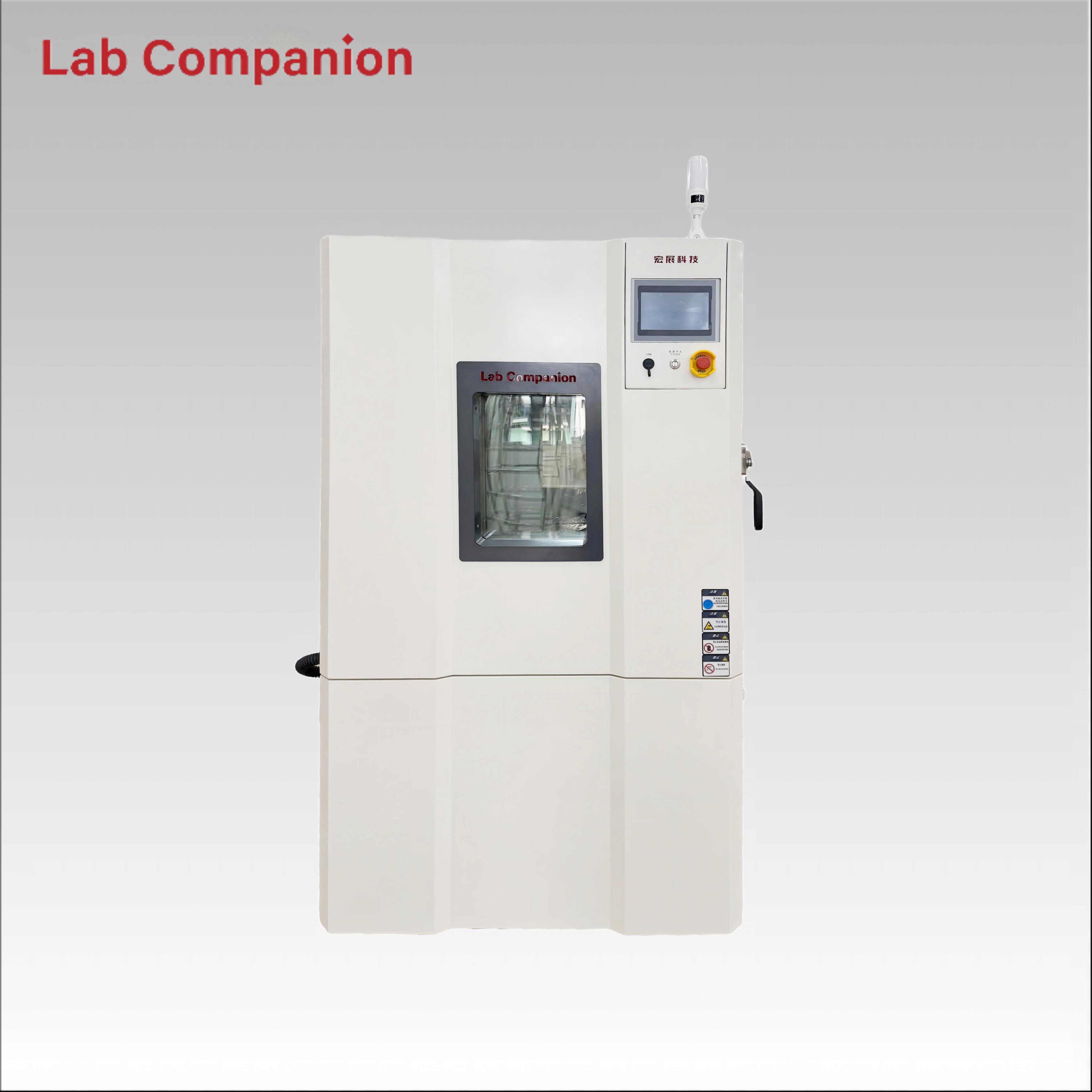
  • Lab Companion TC Series Temperature Chambers | Fully Compliant with IEC 60068-2-14 Test Nb
    Aug 22, 2026
    1. Overview of IEC 60068-2-14 Test Nb IEC 60068-2-14 is an international standard for environmental testing of electrical and electronic products, defining three temperature cycling test methods: Test Na, Test Nb, and Test Nc. Test Nb (Temperature change with specified rate) refers to linear, rate-controlled temperature cycling within a single test chamber. Unlike Test Na, which requires rapid sample transfer between separate chambers, Test Nb simulates gradual temperature fluctuations occurring in real service environments, such as daily ambient temperature changes, equipment startup/shutdown thermal variation, and seasonal temperature shifts. This test effectively evaluates thermal mechanical stress, material expansion matching, solder joint fatigue, and component thermal durability of electronic products. The latest updated version IEC 60068-2-14:2023 has tightened tolerance requirements, upgraded severity level definitions, and standardized test report & data traceability rules, raising higher requirements for test equipment accuracy and data credibility. 2. Core Requirements of Test Nb • Temperature change rate: 1℃/min ~ 15℃/min linear ramp • Test environment: Complete high-low temperature cycling in one single chamber • Key evaluation indicators: Ramp rate accuracy, temperature uniformity, temperature overshoot control, and full-process data recording 3. Lab Companion Company Profile Founded in 2005, Lab Companion is a professional manufacturer of environmental reliability test equipment. With R&D and mass production base located in Dongguan, China, the company has focused on temperature & humidity testing solutions for over 20 years. All TC series temperature chambers are fully compliant with IEC 60068-2-14 and GB/T 2423.22 standards, supporting standardized temperature cycling tests for global certification and industrial reliability verification. 4. Lab Companion TC Series Full Compliance with Test Nb 4.1 Wide Temperature Range Covers All Test Nb Working Conditions The TC series provides a temperature range of -70℃ to +150℃, fully covering all conventional and severe temperature cycling ranges specified in IEC 60068-2-14 Test Nb. It supports standard -40℃~+85℃ cycling as well as high-severity -55℃~+125℃ testing for automotive and semiconductor applications. 4.2 Precise Linear Ramp Rate Matches Standard Rate Specification TC series offers 5 adjustable ramp speeds: 5℃/min, 10℃/min, 15℃/min, 20℃/min, 25℃/min. The linear temperature change mode fully meets the 1℃/min~15℃/min rate requirement of Test Nb. Equipped with advanced self-developed control algorithms, the chamber maintains stable linear rising/falling speed with minimal temperature overshoot and excellent internal temperature consistency, ensuring repeatable and authoritative test results. 4.3 High Precision Temperature Control Ensures Test Repeatability To meet the strict tolerance requirements of the 2023 IEC updated standard, TC series delivers excellent temperature performance: • Temperature fluctuation: ±0.5℃ • Temperature deviation: ±1.5℃ ~ ±2℃ Uniform temperature distribution inside the chamber ensures all DUTs receive consistent thermal stress, which is the core guarantee for reliable and repeatable Test Nb verification. 4.4 Intelligent Controller with Pre-set IEC Standard Programs TC series adopts C100 / Q8 intelligent control system, which stores built-in standard test templates for IEC 60068-2-14 Test Nb. Users can directly call standard temperature range, ramp rate, cycle times and dwell time parameters with one click, avoiding manual setting errors. The system supports more than 100 groups of custom program storage and complex temperature curve editing for diversified industrial test demands. 4.5 Complete Data Traceability Meets 2023 Standard Report Requirements The latest IEC 60068-2-14:2023 mandates standardized test data recording and reporting. Lab Companion Q8 control system supports full-process real-time data recording (1-second sampling interval), storing over 100,000 sets of running data, temperature records and alarm logs. Data can be exported in PDF, Excel and CSV formats, fully satisfying CNAS audit, factory inspection and international certification traceability requirements. 4.6 Full Volume Size Coverage TC series covers versatile chamber sizes for different test samples: Standard stock volumes: 80L, 150L, 225L, 408L, 800L Custom volume range: 80L ~ 8000L It adapts to small component sampling, PCBA module testing, and full-size product batch cycling tests. 5. Industrial Application Scenarios 5.1 Consumer Electronics Widely used for temperature cycling verification of PCBs, connectors and sensors in smartphones, wearables and household electronics. Pre-set IEC standard programs effectively eliminate human operation errors on production lines. 5.2 Automotive Electronics TC series supports pre-testing for AEC-Q100 automotive certification. Stable rate control and high reliability fully meet the strict temperature cycling requirements of automotive-grade chips and vehicle electronic modules. 5.3 Semiconductor Packaging & Testing Effectively verifies thermal stress resistance of chip packaging, solder layers and composite materials, helping detect failure risks such as delamination and solder cracking caused by thermal expansion coefficient mismatch. 5.4 Optical Communication Devices Suitable for temperature screening of optical modules, lasers and detectors, compliant with GR-468-CORE industry standards, ensuring stable optical power and wavelength performance under temperature cycling conditions. 6. Conclusion IEC 60068-2-14 Test Nb is a globally recognized benchmark for electronic product thermal reliability testing. The 2023 new version further raises standards for equipment accuracy, stability and data standardization. Lab Companion TC Series Temperature & Humidity Chambers provide full-dimensional compliance with Test Nb requirements through ultra-wide temperature range, precise linear ramp control, high-precision temperature stability, built-in IEC standard programs, and complete data traceability. We provide reliable, standardized and certification-ready temperature cycling test solutions for global customers in consumer electronics, automotive, semiconductor and optical communication industries.
    और पढ़ें
  • Lab Companion Temperature & Humidity Chambers: Full-Spectrum GB/T 2423.22 Thermal Cycling Curve Replication Lab Companion Temperature & Humidity Chambers: Full-Spectrum GB/T 2423.22 Thermal Cycling Curve Replication
    Aug 20, 2026
    1. GB/T 2423.22: Global Benchmark for Electronic Thermal Cycling Testing GB/T 2423.22 is a key international-aligned environmental testing standard for electrical and electronic products. It specifies temperature variation test procedures to evaluate product reliability under gradual or abrupt temperature changes, verifying structural stability, material tolerance, and functional durability against repeated thermal expansion and contraction stress. 1.1 Engineering Purpose of Thermal Cycling Testing Electronic devices are continuously exposed to fluctuating temperatures during daily operation, outdoor service, seasonal changes, transportation, and power on/off cycles. Different materials within a single device—including FR-4 PCB substrates, copper traces, BGA solder joints, plastic connectors, and metallic shields—feature distinct coefficients of thermal expansion (CTE). Repeated temperature cycling generates continuous thermo-mechanical stress at material interfaces. While invisible at room temperature, cumulative stress over dozens or hundreds of cycles eventually causes common failures such as solder cracking, connector loosening, seal aging, and structural deformation. For this reason, GB/T 2423.22 thermal cycling has become a mandatory reliability test for consumer electronics, industrial equipment, automotive electronics, and telecommunication devices worldwide. 1.2 Two Core Test Methods Defined by GB/T 2423.22 The standard defines two temperature cycling methods to cover extreme and daily environmental conditions: Test Na (Rapid Temperature Shock): Simulates extreme ambient temperature mutation with a maximum transition time of 3 minutes, evaluating product resistance against sudden thermal impact. Test Nb (Controlled Rate Temperature Cycling): The most widely adopted industrial testing method. It simulates real-world gradual temperature fluctuations with customizable ramp rates. Typical industrial parameters include a temperature range of -40℃ to +85℃, a standard ramp rate of 1℃/min, dwell time over 1 hour per stage, and 5 to 100 test cycles. Since Test Nb closely matches actual service conditions and produces highly repeatable and referable test data, it is the primary requirement for most electronic product qualification programs and demands high-precision, stable environmental test equipment. 2. Lab Companion Temperature & Humidity Chamber: High-Precision GB/T 2423.22 Test Nb Solution Lab Companion is a professional high-tech manufacturer specializing in high-precision environmental test chambers. With three advanced manufacturing bases in Dongguan, Kunshan, and Chongqing and a total production area of over 27,000 square meters, we deliver stable, compliant, and customizable environmental testing equipment for global reliability laboratories and manufacturing enterprises. Lab Companion TH series temperature and humidity chambers are fully engineered to meet GB/T 2423.22, IEC, MIL, GJB, and other international environmental testing standards, enabling 1:1 accurate replication of full-range Test Nb thermal cycling curves. 2.1 Ultra-Wide Temperature Range for Extended Test Coverage While the standard GB/T 2423.22 test range is -40℃ to +85℃, Lab Companion chambers support a broad temperature spectrum from -70℃ to +150℃. This extended coverage fully meets standard requirements and reserves sufficient margin for advanced testing scenarios, including automotive electronics (-40℃ to +125℃) and aerospace extreme temperature validation. We provide multiple standard chamber capacities including 80L, 150L, 225L, 408L, and 800L with in-stock availability. Custom sizes from 80L to 8000L are also supported to fit diverse sample volumes and batch testing needs. 2.2 Precise Temperature Control Ensures Repeatable Test Results Accurate temperature uniformity and stability are critical for valid thermal cycling test data. Lab Companion chambers deliver industry-leading precision with temperature fluctuation of ±0.5℃ and temperature deviation of ±2℃. The uniform internal temperature field ensures all DUTs (devices under test) receive consistent thermal stress throughout long-term cyclic testing. Even during 100+ continuous cycling procedures specified in GB/T 2423.22, the chamber maintains stable thermal conditions, eliminating batch-to-batch deviation and ensuring fully repeatable and traceable test data. 2.3 Full-Range Humidity Control for Combined Environmental Stress Testing Lab Companion integrated humidity system covers a full humidity range of 20%RH to 98%RH, with precise humidity deviation: ±3.0%RH for humidity below 75%RH and ±5.0%RH for humidity above 75%RH. Although GB/T 2423.22 focuses on temperature cycling, real application environments involve coupled temperature and humidity aging. Lab Companion chambers support synchronized temperature and humidity alternating testing, enabling one-stop comprehensive environmental reliability validation for complex product qualification standards. 2.4 Programmable Ramp Rate for Custom Standard Curve Replication To fully comply with Test Nb’s customizable temperature ramp requirements, Lab Companion chambers support multi-grade linear and non-linear temperature change rates including 5℃/min, 10℃/min, 15℃/min, 20℃/min, and 25℃/min. Users can freely set ramp rates according to internal specifications or industrial standards to restore exact standard thermal cycling curves. Equipped with an intuitive Q8 color-touch PLC controller, the chamber stores more than 100 groups of test programs, with up to 999 steps per program. Pre-set standard test procedures can be recalled with one click, effectively avoiding manual setup errors and improving laboratory testing efficiency and standardization. 3. Industrial-Grade Hardware & Global Compliance Certification 3.1 Durable Structural Design for Long-Term Continuous Operation The internal chamber adopts SUS304 stainless steel with rounded corner seamless design for easy cleaning and corrosion resistance. A 100mm thick composite insulation layer of high-density polyurethane and glass fiber prevents condensation and cold loss under low-temperature conditions. The chamber door is fitted with dual-layer high and low temperature resistant silicone sealing strips and an independent anti-condensation heating system. The three-layer vacuum tempered glass observation window comes with automatic defrosting for real-time sample monitoring. A reserved φ50mm test port (expandable to φ100mm) supports external sensor connection and extended testing functions. 3.2 Premium Core Components Guarantee Stable Long-Cycle Operation Lab Companion chambers adopt internationally renowned brand compressors (Tecumseh, Bitzer) with cascade dual-stage refrigeration and eco-friendly R404a + R23 refrigerant, ensuring efficient, stable, and low-energy cooling performance during long cyclic tests. The heating system uses nickel-chromium alloy finned heating tubes with SSR non-contact relay control for uniform and stable temperature rise. The boiler-type steam humidification system with an external auto-refill water tank provides fast humidity response without overshoot, perfectly adapting to long-duration temperature and humidity alternating tests. 3.3 Global Standard Compliance & CE Certification All Lab Companion temperature and humidity chambers areCE certified and fully compliant with GB/T, IEC, MIL, JIS, GJB and other international environmental testing standards. Equipment parameters completely cover all GB/T 2423.22 test specifications, ensuring test reports are authoritative, valid, and globally recognized for product certification and market entry. 4. Conclusion GB/T 2423.22 is a universally recognized standard for electronic product thermal cycling reliability verification. With Test Na covering extreme thermal shock and Test Nb simulating real-world gradual temperature fluctuation, the standard provides comprehensive environmental assessment solutions for global electronic manufacturing industries. As a reliable global environmental test equipment supplier, Lab Companion delivers high-precision, stable, and fully compliant temperature and humidity chambers for GB/T 2423.22 full-condition testing. With ultra-wide temperature and humidity coverage, accurate closed-loop control, customizable cycling curves, and industrial-grade durability, our equipment empowers global laboratories and manufacturers to complete standardized thermal reliability validation and improve product market competitiveness.
    और पढ़ें
1 2 3 4 5 6 7 8
कुल8पृष्ठों

एक संदेश छोड़ें

एक संदेश छोड़ें
यदि आप हमारे उत्पादों में रुचि रखते हैं और अधिक जानकारी जानना चाहते हैं, तो कृपया यहां एक संदेश छोड़ दें, हम जितनी जल्दी हो सके आपको जवाब देंगे।
जमा करना

घर

उत्पादों

Whatsapp

हमसे संपर्क करें