हमें ईमेल करें :
info@labcompanion.cn
-

-

कॉल का अनुरोध करना :
+86 18688888286

1. Operational Challenges of Long-Duration Thermal Cycling Testing
Thermal cycling is one of the most frequent and time-consuming reliability tests for consumer electronics, semiconductors, and automotive electronic components. In accordance with mainstream industry standards including JESD47 and AEC-Q100, semiconductor ICs require up to 1000 complete thermal cycles, while automotive component testing often lasts hundreds of hours. Continuous 7×24-hour chamber operation has become standard for modern reliability laboratories.
Conventional thermal cycling chambers with fixed-frequency single-stage refrigeration widely suffer from three critical drawbacks that raise overall lab operational costs:
• High idle energy consumption: Frequent compressor start-stop cycles during steady-temperature stages cause massive wasted power, leading to high monthly electricity expenses.
• Frequent maintenance & short service life: Long-term high-low temperature alternating operation accelerates wear on refrigeration and air duct components, resulting in frequent part replacement and high labor maintenance costs.
• Temperature overshoot & energy conflict: Poor temperature control accuracy causes continuous heating and refrigeration system counteraction to maintain standard temperature tolerances, further increasing power consumption.
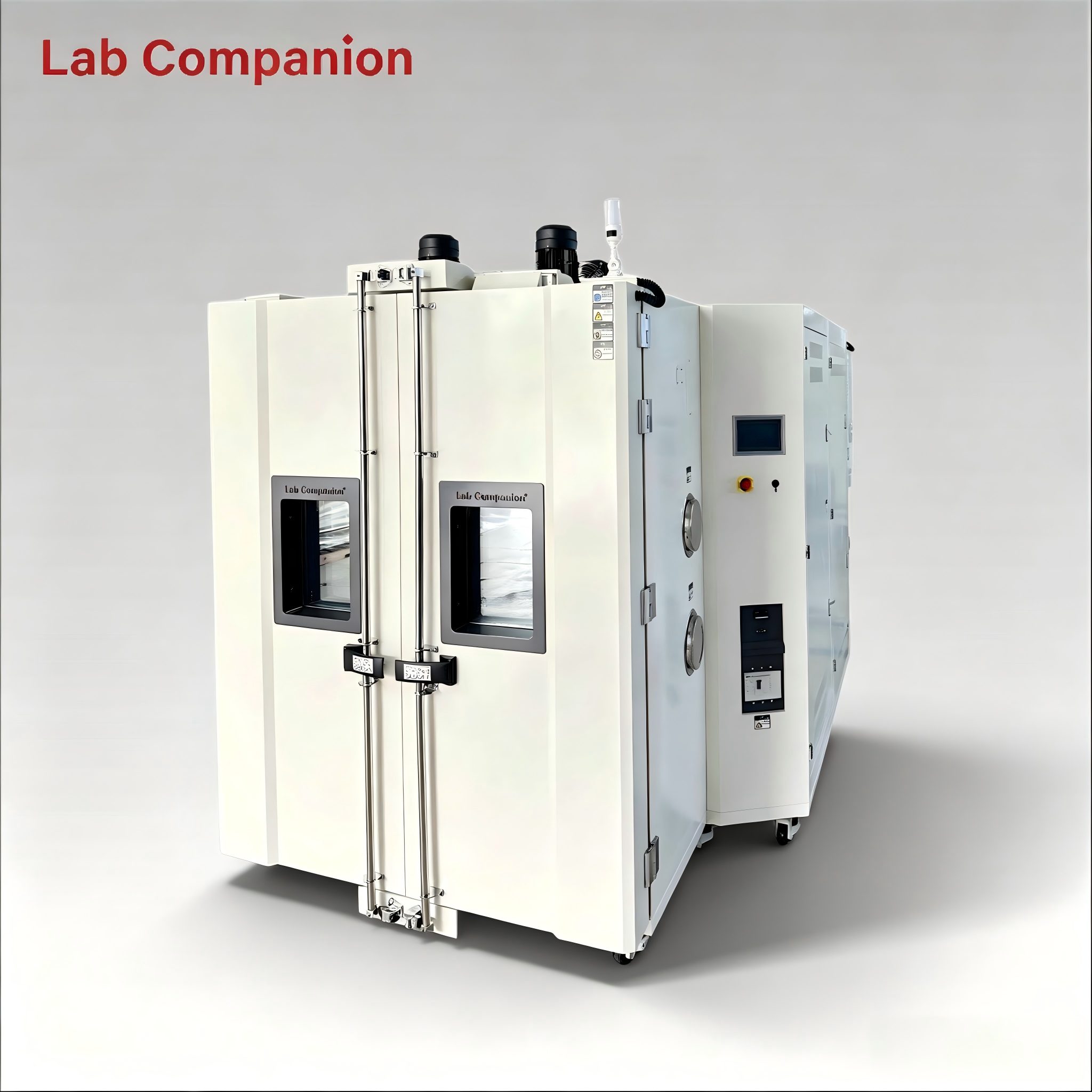
To solve the pain points of high energy consumption and high maintenance frequency in long-duration thermal cycling tests, Lab Companion has fully optimized the TC series energy-saving thermal cycling chambers. Equipped with self-developed dual-stage cascade variable-frequency refrigeration, adaptive air duct system and multi-layer structural protection, the TC series fully complies with JESD22-A104 standards while reducing comprehensive energy consumption by 30% compared with traditional models. It extends core component service life and effectively lowers long-term laboratory operation and maintenance costs.
2. Core Hardware & Energy-Saving Configuration of Lab Companion TC Series
2.1 Standard Temperature Performance: Full Compliance with JEDEC Standards
The Lab Companion TC series covers a temperature range of -70℃ to +150℃, with temperature fluctuation ≤0.5℃, cavity deviation ±1.5℃, and full-load uniformity ≤±2℃. Every unit completes a 3-hour 9-point temperature field calibration before delivery, fully meeting Condition A, G, H, T and all other working conditions specified in JESD22-A104.
Standard ramp rates include 5℃/min, 10℃/min and 15℃/min. Custom models support 20℃/min and 25℃/min. The system supports fixed linear rate control from 10℃/min to 14℃/min for solder joint reliability testing, eliminating temperature overshoot and energy waste caused by sudden rate changes.
2.2 Dual-Stage Cascade Variable-Frequency Refrigeration System
The TC series adopts a high-efficiency dual-stage cascade refrigeration system, with R23 refrigerant for the low-temperature stage and R404A for the high-temperature stage. Equipped with imported variable-frequency dual-stage compressors and plate heat exchangers, its heat exchange efficiency is 30% higher than traditional single-stage fixed-frequency systems.
• Adaptive power adjustment: The compressor automatically outputs optimal power according to real-time cavity load, cooling/heating ramps and steady-state holding. Low-frequency operation during temperature holding eliminates the “full-on / full-off” energy waste of fixed-frequency compressors.
• Precision cooling capacity control: The system reduces cooling output during heating and precisely matches cooling demand during cooling, avoiding simultaneous high-power heating and refrigeration conflict. Energy consumption in steady-state holding is reduced by 40%.
• Eco-friendly & high-efficiency refrigerant: Zero ODP refrigerant reduces compressor load during long-cycle operation and delivers stable energy-saving performance.
2.3 Auxiliary Energy-Saving Structure: Air Duct & Thermal Insulation Optimization
• Variable-frequency dual air duct system: AI-PID algorithm dynamically adjusts fan speed according to no-load, full-load and steady-state conditions, avoiding continuous full-speed fan operation and reducing airflow power consumption.
• High-density thermal insulation & double sealing: Integrated polyurethane insulation and double-layer door sealing minimize internal and external heat exchange, reducing temperature compensation energy loss.
• High-efficiency alloy heating tubes: Nickel-chromium finned heating tubes provide fast thermal response and high heat conversion efficiency, shortening high-power heating duration.
2.4 Multi-Protection & Modular Design: Lower Long-Term Maintenance Cost
The TC series integrates over-temperature, high-pressure, fan interlock and compressor delay start protection mechanisms to prevent component overload damage during 7×24h continuous operation. The 304 stainless steel inner chamber and anti-corrosion heating components remain stable after thousands of thermal cycles without oxidation or aging.
All easily consumable parts including air filters, sensors and heating modules adopt independent modular structures. Lab technicians can complete daily cleaning, replacement and calibration without professional on-site maintenance, greatly reducing service labor costs and downtime.
3. Stable & Energy-Saving Performance in Standard JEDEC Test Scenarios
3.1 1000-Cycle Semiconductor Thermal Cycling (Condition A)
According to JESD47, semiconductor IC reliability testing requires 1000 cycles of Condition A (-55℃~+85℃), including 10 min low-temperature soak, linear heating, 10 min high-temperature soak and linear cooling.
Traditional fixed-frequency chambers consume massive power due to frequent compressor activation and temperature overshoot. Lab Companion TC series adjusts cooling output intelligently during soaking stages, delivering 30% overall power savings for the full 1000-cycle test. Stable temperature ramp control eliminates parameter drift and avoids retest energy waste caused by unqualified test data.
3.2 Automotive-Grade Condition G Continuous Cycling
Automotive electronic testing adopts Condition G (-40℃~+125℃) with large thermal capacity samples and high system load. The TC series supports stable 10℃/min linear ramping to meet automotive solder fatigue test requirements. The variable-frequency refrigeration system adapts to high-load samples without temperature overshoot or field deviation.
Field verification shows that after 500 consecutive cycles of 7×24h unattended operation, the chamber maintains stable cooling performance and consistent temperature uniformity without downtime maintenance, saving labor cost and invalid test time.
3.3 Hardware-Embedded Rate Lock to Avoid Invalid Retest Cost
Many low-cost chambers suffer from uncontrolled ramp speed, resulting in non-compliant test data and full sample retests, which waste electricity, materials and manpower.
Lab Companion TC series provides hardware-level ramp rate locking. The maximum speed can be preset and locked to prevent ultra-fast temperature changes, ensuring full JESD22-A104 compliance and eliminating hidden costs from repeated testing.
4. Full-Lifecycle Maintenance & Energy-Saving Solutions
4.1 Factory Warranty & Localized After-Sales Support
Lab Companion provides a 3-year full machine warranty and extended warranty for core components including compressors and heating elements. Professional technical support ensures fast troubleshooting and minimizes test downtime. Complete factory calibration reports and energy-saving parameter guides help users optimize operating efficiency.
4.2 Simplified Modular In-House Maintenance
Modular consumable design enables lab staff to complete daily maintenance including filter cleaning, door seal replacement and sensor calibration independently. Standard monthly, quarterly and annual maintenance schedules prevent abnormal energy consumption caused by component aging and failure.
4.3 Batch Reusable Standard Energy-Saving Programs
The touchscreen controller stores more than 100 groups of standard test programs, including pre-configured Condition A/G and low-speed high-capacity test templates. Optimized frequency and fan speed parameters can be recalled with one click. USB program export and batch synchronization support unified energy-saving operation for multiple chambers, realizing standardized laboratory energy management.
5. Practical Energy-Saving Benefits for Different Industries
5.1 Consumer Electronics PCBA ESS Screening Labs
Mass-production ESS stress screening runs 8 hours daily under Condition A. Replacing traditional chambers with Lab Companion TC models saves over 10,000 kWh of electricity per unit annually and reduces 2–3 annual refrigeration system maintenances. The overall lab operation cost decreases by approximately 25%, while stable temperature cycling ensures consistent screening quality without repeated testing.
5.2 Semiconductor Packaging & R&D Labs
Semiconductor labs require long-term 7×24h operation for 1000-cycle IC aging tests. The TC series cascade variable-frequency system delivers outstanding energy-saving performance during long soaking stages, reducing core component wear and avoiding major compressor maintenance within three years. Optional external thermocouple monitoring realizes accurate sample-based temperature judgment and avoids unnecessary power consumption from redundant soaking time.
5.3 Automotive Component Certification Labs
Automotive test samples feature large thermal capacity and high load, which easily cause performance attenuation in traditional equipment. Lab Companion TC series adapts to high-load operation stably, fully meeting AEC-Q100 certification requirements. It effectively avoids retest losses caused by temperature field deviation, saving hidden costs of samples, electricity and labor.
6. Conclusion
For reliability laboratories, the long-term hidden costs of electricity consumption, maintenance and repeated testing far exceed the initial equipment procurement cost. As a professional reliability test equipment brand, Lab Companion TC series thermal cycling chambers integrate cascade variable-frequency refrigeration, adaptive air duct control, high-density insulation and modular maintenance design. While fully complying with JESD22-A104 international standards, the series reduces comprehensive energy consumption by 30% and lowers long-term maintenance frequency.
For laboratories with high-frequency, long-cycle and high-standard thermal cycling requirements, the Lab Companion TC series provides a reliable, standard-compliant and cost-effective solution to achieve stable testing quality and full-lifecycle energy-saving operation.
 एक कहावत कहना


 IPv6 नेटवर्क समर्थित